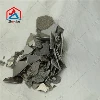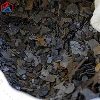

The chemical and physical structure of silicon nitride depends on the ratio of silicon to nitrogen. This compound's crystal structure is mainly tetrahedral. Each nitrogen atom is connected to three silicon atoms, forming a network of strong covalent bonds. The microstructure can be changed using different synthesis methods, resulting in different shapes, such as granules, powders, or blocks. Each shape meets specific industrial needs.
Silicon nitride is very hard. Silicon nitride is harder than most metals and ceramics, making it resistant to wear.
- Stable at high temperatures: Silicon nitride can withstand temperatures up to 1700°C, making it ideal for high-temperature applications.
- Resists corrosion: Silicon nitride can't be destroyed by most chemicals, including acids and alkalis.
- Insulates electricity: Silicon nitride is a good insulator, even though it conducts heat. This makes it ideal for high-voltage applications.
- Heat conductivity: It conducts heat well, so it's useful in thermal management systems.
There are several ways to make silicon nitride:
- By heating it until it decomposes. Silicon reacts with ammonia at high temperatures to form silicon nitride.
- Chemical vapour deposition (CVD): Silicon and ammonia react to make a thin film of silicon nitride.
- Reaction sintering: Silicon powder and ammonia react at high temperatures to make a bulk silicon nitride structure.