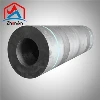

What Magnesite Carbon Bricks Are
Magnesite carbon bricks are basic refractories made from high-purity dead-burned magnesia, natural or synthetic graphite, and a carbonaceous binder such as phenolic resin. The graphite phase forms a continuous network that shields the magnesia grains from slag penetration, while the ceramic bond between individual MgO grains provides the load-bearing skeleton. This two-phase structure is why the brick keeps both its strength and its geometry in converter, ladle and electric arc furnace service, where lining temperatures routinely exceed 1600 °C and slag chemistry changes from heat to heat.
Composition and Microstructure Behind the Strength
Strength in a magnesia carbon brick is never a single number. It results from the balance between MgO purity and grain sizing, graphite content and flake size, binder type, and the pressing and curing route. Coarse fractions carry the load, intermediate fractions fill the voids left between the coarse grains, and fines plus binder close the remaining porosity. Antioxidant additions such as aluminium or silicon powder protect the carbon network from oxidation at the hot face and, in service, form secondary phases that reinforce the matrix.
| Parameter | Typical range |
|---|---|
| MgO content | 70–85 % |
| Total carbon | 8–20 % |
| Bulk density | 2.85–3.05 g/cm³ |
| Apparent porosity | 3–8 % |
| Cold crushing strength | 30–50 MPa |
| Refractoriness under load, T0.6 at 0.2 MPa | ≥ 1650 °C |
Bulk density and apparent porosity are measured on cored specimens following ASTM C20, while cold crushing strength and modulus of rupture follow ASTM C133. Finished bricks are dimensionally inspected against GB/T 22589, the standard covering magnesia carbon bricks for steelmaking vessels, which sets the grading, tolerance and inspection rules that let a buyer compare suppliers on the same basis.
Mechanical Behaviour at Service Temperature
Room-temperature strength is only a screening value. The property that decides campaign life is hot strength, expressed as hot modulus of rupture and refractoriness under load. A brick with dense magnesia grains, a well-graphitised carbon bond and a controlled antioxidant level can carry its own weight plus the load of the courses above it at 1500–1600 °C without slumping. Because the carbon network accommodates thermal expansion, the same brick also tolerates the differential strain imposed when the slag line runs hotter than the lower courses.
Wear in a basic lining is normally a combination of three mechanisms: chemical attack by FeO and MnO in the slag, mechanical erosion from tapping and scrap impact, and spalling driven by thermal cycling. A high-strength brick with low open porosity reduces all three at the same time, which is the practical reason a stronger brick frequently costs less per ton of steel than a cheaper brick that must be replaced sooner.
Applications Where Strength and Durability Matter Most
Converter linings, where slag-line bricks resist FeO-rich slags and repeated charging impacts.
Ladle sidewalls and bottoms, where the lining sees tapping erosion, thermal cycling and long holding times.
Electric arc furnace hot spots and slag lines, where high power input and scrap melting create severe local wear.
Torpedo ladles and mixers in iron transport, where mechanical abrasion dominates the wear pattern.
Non-ferrous furnaces and cement kilns that need basic resistance to alkali and clinker attack.
In every duty the selection logic is the same: match carbon content to the slag and the thermal regime, keep MgO purity high where chemical attack is aggressive, and specify dimensions that allow tight joints so that hot metal cannot reach the steel shell through wide mortar lines.
Service Life, Quality Control and Cost per Campaign
Buying on unit price alone usually produces a higher cost per ton of product. Evaluate the brick on cost per campaign instead: a lining that lasts 20 % longer at a 10 % price premium is already a net saving before maintenance labour and lost production are counted. Reliable supply matters for the same reason, because a delayed brick stops a vessel. Suppliers control this by batching raw materials, checking grain sizing and moisture before mixing, monitoring press density, and curing to a schedule that fully cross-links the resin binder.
Storage and installation practice affect the delivered result as much as the brick itself. Bricks must stay dry, protected from rain and from oil contamination, and joints should be kept thin and fully filled with a compatible dry mix or mortar so that the lining behaves as one body rather than a stack of loose blocks.
Frequently Asked Questions
Q: What MgO and carbon contents suit a converter slag line?
Converter slag-line bricks normally carry 76–84 % MgO with 14–18 % carbon, so graphite shields the magnesia from FeO-rich slag while the MgO fraction resists chemical dissolution.
Q: Why does a higher carbon content not always mean a longer life?
More graphite improves slag resistance and thermal shock tolerance but lowers strength and heat-transfer performance, so the optimum is set by the slag, the thermal load and the mechanical abuse in that specific zone.
Q: How is thermal shock resistance assessed?
Quench cycling with residual strength measurement, as described in ASTM C1171, quantifies the damage caused by repeated temperature change far better than a single room-temperature strength value.
Q: Which antioxidants are used, and why?
Aluminium and silicon powders are added so that they combine with oxygen before it attacks the carbon network; the reaction products also form ceramic phases that reinforce the matrix at the hot face.
Q: How should magnesia carbon bricks be stored before installation?
Store them indoors or under cover in a dry, ventilated area, keep pallets off the ground, and avoid long exposure to moisture, since the resin bond and the graphite can be degraded before the bricks are laid.
Q: Are custom shapes available?
Yes. Bricks for cones, bottoms and special hot spots are produced from drawings or templates with controlled dimensional tolerances, and each block is normally marked with its position to support controlled installation.