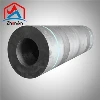

What Premium Magnesium Carbon Refractory Is
Premium magnesium carbon (MgO-C) refractory is a composite material produced from high-purity dead-burned or fused magnesia and carefully selected carbonaceous materials such as flake graphite and carbon black. During manufacturing the carbon is dispersed evenly through the magnesia matrix, so the finished brick combines the high refractoriness and slag resistance of magnesia with the thermal conductivity and thermal shock resistance of graphite. The result is a lining material that transfers heat efficiently while resisting the severe thermal cycling found in steelmaking and smelting vessels.
Because heat conduction depends on both the graphite network and the bond structure, raw material selection, mixing sequence, pressing pressure and the curing cycle are all controlled to keep porosity low and carbon distribution uniform.
How Optimal Heat Conduction Is Achieved
Uniform carbon distribution: fine graphite and carbon black are blended under controlled conditions so that no carbon-starved zones interrupt the heat path.
High-purity magnesia: low silica and low iron oxide content limits low-melting phases that would otherwise reduce refractoriness and disturb the matrix.
Optimised binder system: a carbon-rich bond formed during curing and tempering creates continuous conduction paths between magnesia grains.
Controlled porosity: high pressing pressure and staged curing reduce open porosity, which lowers thermal resistance across the brick.
Graded grain structure: coarse, medium and fine fractions are proportioned to balance conductivity with thermal shock resistance.
Typical Performance Parameters
| Property | Typical range |
|---|---|
| MgO content | 76-82 % |
| Carbon content | 10-18 % |
| Bulk density | 2.85-2.95 g/cm3 |
| Apparent porosity | not more than 5 % |
| Cold crushing strength | 35-45 MPa |
| Refractoriness under load (0.2 MPa) | not lower than 1650 degC |
Values depend on the carbon grade selected and on the service position, and each production batch is verified by test report before it leaves the works.
Where Optimal Heat Conduction Matters
High thermal conductivity is valuable wherever heat must move quickly through the refractory and away from the working face:
Converter and electric arc furnace linings, where rapid heat transfer reduces hot-spot damage.
Ladle and torpedo car working linings exposed to repeated tapping cycles.
Metallurgical vessels in glass and non-ferrous melting where thermal gradients cause spalling.
Energy and process equipment requiring stable thermal performance over long campaigns.
In these positions the combination of conductivity and thermal stability lowers peak shell temperatures, reduces thermal stress at the hot face and keeps the lining dimensionally stable.
Service Life and Maintenance Practice
Thermal shock resistance and slag resistance determine how long an MgO-C lining holds its profile. Practical measures that extend service life include keeping the slag line within the design range, avoiding unnecessary cooling between heats, applying gunning or patching mixes that match the brick chemistry, and measuring wear at planned intervals so that relining is scheduled instead of reactive.
Frequently Asked Questions
Q: Does higher carbon content always mean better heat conduction?
Not necessarily. Conductivity rises with carbon content up to a point, but very high carbon levels can reduce strength and oxidation resistance, so the grade is matched to the service position.
Q: How does magnesium carbon compare with alumina based refractories?
Magnesium carbon offers higher thermal conductivity and better resistance to basic steelmaking slags, while alumina based materials are usually chosen for acidic or neutral service.
Q: Why is low porosity important for heat conduction?
Pores act as thermal barriers. Reducing open porosity shortens the conductive path through the matrix and also limits slag penetration at the working face.
Q: Can the material be supplied in different shapes?
Yes. Magnesium carbon is produced as standard bricks, wedge and key shapes, and special shapes pressed from tooling developed for a specific vessel.
Q: What causes premature failure of an MgO-C lining?
The most common causes are thermal spalling from rapid heating or cooling, oxidation of the carbon phase, and slag attack along the slag line; each is addressed by grade selection and operating control.
Q: How is quality verified before delivery?
Each batch is checked for chemical composition, bulk density, apparent porosity and cold crushing strength, and the results are recorded against the specification agreed for the order.