
Carbon Grades of Ferromanganese
Ferromanganese is the standard manganese-bearing ferroalloy used to introduce manganese into steel and to control sulphur, and it is classified commercially by carbon content. Low carbon ferromanganese contains no more than 0.7 percent carbon, medium carbon ferromanganese covers the range above 0.7 percent up to 2.0 percent, and high carbon ferromanganese covers the range above 2.0 percent up to about 8.0 percent. The boundaries matter because carbon pick-up in the ladle must be kept inside the specification of the steel being made.
High carbon ferromanganese is therefore the workhorse grade for carbon and low-alloy steelmaking, where carbon pick-up is acceptable and the low cost per unit of manganese is the deciding factor. Low and medium carbon grades are reserved for steels where carbon must be tightly limited, such as certain stainless and low-carbon grades.
Blast Furnace Production Route
High carbon ferromanganese is produced by two main routes: blast furnace smelting and electric furnace smelting. In the blast furnace route, manganese ore, coke and lime are charged into the furnace and smelted to produce blast furnace ferromanganese with a manganese content of roughly 52 to 76 percent and a phosphorus content of about 0.4 to 0.6 percent.
The only fundamental difference between the blast furnace and the electric furnace for smelting high carbon ferromanganese is the source of heat. Because the heat source differs, the two furnaces have different structures, geometries and operating methods, but the smelting principle is the same: manganese oxides are reduced by carbon in the presence of a lime-bearing slag that controls slag basicity and protects the metal bath.
Electric Furnace Smelting Routes
Electric furnace smelting of high carbon ferromanganese is carried out by several variants, usually described as the fluxless method, the flux method and the low-flux method. The flux method is the most widely adopted route, and it also has the widest raw material flexibility.
In the flux method, lime is charged together with manganese ore and coke, and smelting is carried out with a high basicity slag, typically with a basicity ratio in the range of 1.3 to 1.4. A sufficient quantity of reductant is used so that the manganese content of the slag is kept as low as possible, which maximises the recovery of manganese into the alloy. This method can smelt both low-grade and high-grade manganese ores, which is why it dominates commercial production.
Why Blast Furnace Metal Carries More Phosphorus
Even when the same manganese ore is smelted, the phosphorus content of the two products is not the same. Blast furnace ferromanganese typically contains about 0.07 to 0.11 percentage points more phosphorus than the electric furnace product, and the reason lies in the charge and the thermal conditions.
Coke ratio: the coke charge used in blast furnace smelting is about five to six times that used in electric furnace smelting, so much more phosphorus is introduced with the reductant.
Furnace temperature: the blast furnace operates at a lower temperature, so the volatilisation of phosphorus during smelting is lower than in the electric furnace by roughly ten percent.
Practical consequence: where phosphorus must be controlled to a low level, the electric furnace route gives more freedom in metal selection, or a low-phosphorus manganese ore must be used in the blast furnace charge.
Composition and Specification Reference
| Parameter | Blast furnace route | Electric furnace route |
|---|---|---|
| Main charge | Manganese ore, coke, lime | Manganese ore, coke, lime, with high basicity slag |
| Heat source | Combustion of coke in the furnace | Electrical energy in the furnace |
| Manganese content of product | About 52 to 76 percent | Set by charge and slag practice |
| Phosphorus content | About 0.4 to 0.6 percent | About 0.07 to 0.11 percentage points lower than blast furnace product |
| Coke consumption | Roughly five to six times the electric furnace figure | Reference level |
| Typical carbon range | 2.0 to 8.0 percent for the high carbon grade | 2.0 to 8.0 percent for the high carbon grade |
Commercial deliveries are normally specified against a ferroalloy standard such as GB/T 3795 for ferromanganese, ASTM A99, or ISO 5447, which define the grade designation, chemical composition ranges, size fractions and sampling requirements. Buyers should confirm the grade, the manganese and carbon ranges, the maximum phosphorus limit and the size range required by their steelmaking practice before placing an order.
Use, Handling and Storage
High carbon ferromanganese is used mainly for deoxidation and alloying in carbon steel and low-alloy steel production, and for sulphur control through the formation of manganese sulphide instead of iron sulphide, which would otherwise cause hot shortness during rolling. It is also used as an intermediate in the production of manganese metal and manganese-bearing chemicals.
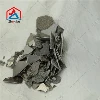
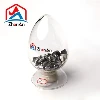
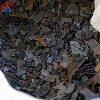
The alloy is supplied in crushed and screened size fractions, commonly in lump form for converter and ladle additions and in finer sizes for smaller vessels. It should be stored dry and segregated by grade and size to prevent mixing, because the carbon and phosphorus content of the charge directly affects the steel analysis. Moisture pick-up should be avoided, and material that has been stored for long periods should be re-checked against the certificate of analysis before use.
Frequently Asked Questions
Q: What is high carbon ferromanganese?
It is the grade of ferromanganese containing more than 2.0 percent and up to about 8.0 percent carbon. It is the main manganese addition used for deoxidation and alloying in carbon and low-alloy steelmaking.
Q: How are the carbon grades of ferromanganese divided?
Low carbon ferromanganese contains no more than 0.7 percent carbon, medium carbon ferromanganese covers above 0.7 percent up to 2.0 percent, and high carbon ferromanganese covers above 2.0 percent up to about 8.0 percent.
Q: Which production methods are used?
Blast furnace smelting and electric furnace smelting. The smelting principle is the same in both; the difference is the heat source, which changes furnace design, geometry and operating method.
Q: What is the flux method in electric furnace smelting?
Lime is charged with manganese ore and coke, and smelting runs with a high basicity slag, typically with basicity of about 1.3 to 1.4, together with sufficient reductant to keep manganese losses in the slag as low as possible.
Q: Why does blast furnace product contain more phosphorus?
Because the blast furnace uses about five to six times the coke of an electric furnace, adding more phosphorus with the reductant, and it operates at a lower temperature, so less phosphorus volatilises during smelting.
Q: Which standards cover ferromanganese delivery?
Ferromanganese is commonly ordered against GB/T 3795, ASTM A99 or ISO 5447, which specify grade designations, chemical composition ranges, size fractions and sampling. The applicable standard should be stated on the purchase order.