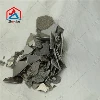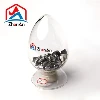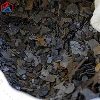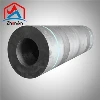

Silicon carbide (SiC) is an engineered compound rather than a mined mineral. It is produced by the Acheson process, in which a mixture of silica sand and a carbon source is heated electrically to about 2200-2500 °C, so that carbon and silicon dioxide react to form SiC. The result is a hard, chemically stable material that behaves as a semiconductor at room temperature and shows impurity conduction.
Its commercial value rests on a combination of properties that rarely appear together: very high hardness, high strength retained at high temperature, good thermal conductivity, chemical inertness and a wide band gap. Those properties explain the very different industries that consume the same material.
Key Properties That Drive Application Selection
| Property | Typical value | Where it matters |
|---|---|---|
| Mohs hardness | 9.0-9.5 | Abrasives, wear parts |
| Density | 3.21 g/cm3 | Charge design, refractory mass |
| Sublimation temperature | about 2830 °C | Furnace linings, kiln furniture |
| Thermal conductivity | high (roughly 100 W/m.K and above for dense grades) | Heat exchangers, electronics |
| Band gap | 2.4-3.3 eV depending on polytype | Power devices |
| Chemical resistance | Attacked only by strong alkali and some molten salts at high temperature | Metallurgical and chemical plant |
Purity also controls electrical behaviour: with increasing purity and temperature, resistivity falls naturally, which is why electronic-grade SiC is refined far beyond abrasive-grade material.
Abrasives: Wheels, Paper and Blasting Media
The oldest and still the largest use of silicon carbide is in bonded and coated abrasives. Because of its hardness and sharp, friable grain, it is used as the abrasive ingredient in grinding wheels, sandpaper, grinding blocks and honing stones. In the electronics industry the same grain performs precision grinding and polishing of piezoelectric crystals, where tight dimensional control matters more than metal removal rate.
Bonded wheels for cast iron, carbide and non-ferrous grinding
Coated abrasives for wood, paint and metal finishing
Loose grain for lapping, blasting and wire sawing
Refractories and High-Temperature Components
Silicon carbide resists corrosion, withstands high temperature, conducts heat well and tolerates thermal shock. Those four properties make it a natural refractory material. It is used for smelting furnace linings, silicon carbide plates, silicon carbide crucibles and kiln lining plates, and it is also applied as a high-temperature indirect heating material in the non-ferrous metal smelting industry, where a conductive, oxidation-resistant element is needed.
Metallurgy and Foundry Practice
In iron and steel foundries SiC acts as both a fuel and a metallurgical additive. It provides a controlled source of carbon and silicon, reduces slag attack on the lining and improves the fluidity of the melt. Deoxidised melts produce cleaner castings with fewer gas defects, which is why SiC briquettes and grain are routinely charged with the scrap.
Electronics and Power Devices
Single-crystal silicon carbide is a wide-band-gap semiconductor. Compared with silicon it offers a higher breakdown field, higher thermal conductivity and the ability to operate at higher junction temperatures, so it is used for Schottky diodes, MOSFETs and high-frequency power switching. The same crystal is used for light-emitting diodes and for high-power, high-temperature sensors. This application also explains why SiC crystal growth and wafer processing demand the highest purity grades available.
How to Choose the Right Silicon Carbide Grade
Metallurgical grade for deoxidation and carbon/silicon addition in the melt.
Abrasive grade, classified by grit size, for bonded wheels, coated paper and blasting.
Refractory grade for kiln furniture, crucibles and furnace linings, where thermal shock dominates.
Electronic grade, in single-crystal or high-purity powder form, for semiconductors and substrates.
Black and green abrasive types differ mainly in impurity level and toughness, and the choice follows the workpiece rather than the price alone.
Frequently Asked Questions
Q: How is silicon carbide made?
By the Acheson process, in which a silica and carbon mixture is electrically heated to roughly 2200-2500 °C so that silicon dioxide reacts with carbon to form SiC.
Q: Why is silicon carbide used as a refractory?
It combines corrosion resistance, high-temperature strength, good thermal conductivity and thermal shock resistance, making it suitable for furnace linings, plates and crucibles.
Q: What is silicon carbide used for in metallurgy?
It is charged as a combined carbon and silicon source, improves melt fluidity and protects the lining from slag attack, which reduces gas defects in the casting.
Q: Is silicon carbide a semiconductor?
Yes. It behaves as a semiconductor at room temperature with impurity conduction, and single-crystal SiC is used for power devices, diodes and high-temperature sensors.
Q: How does purity affect silicon carbide properties?
Higher purity raises the achievable resistivity range and thermal performance, while lower-purity abrasive grades are optimised for hardness and toughness instead.
Q: Is silicon carbide used in abrasive products only?
No. Abrasives are the largest single outlet, but refractories, foundry additives and electronics consume substantial volumes of their own specialised grades.