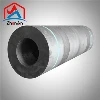

What Is a Silica Brick
Silica brick is a refractory product with silicon dioxide as the main component, and its SiO2 content is generally not less than 93%. The main component is SiO2, which determines both the advantages and the limitations of the brick in service. Silica bricks are classified as acidic refractory materials, and their application range follows directly from this chemical character.
Chemical and Slag Resistance
Silica brick has strong resistance to acidic slag and good resistance to CaO, FeO and Fe2O3 oxides, which makes it suitable for furnaces where acidic slags are present. However, its resistance to alkaline slag erosion is poor, and it can be damaged by the action of Al2O3, K2O and Na2O. For this reason, silica brick is selected where the slag chemistry is compatible with an acid refractory, and it must be protected from alkaline attack and from fluxes such as alumina and alkali oxides.
High-Temperature Behavior
The softening temperature of silica brick under load is as high as 1640-1680°C, and its volume remains relatively stable during long-term use at high temperature. This combination of high load-softening temperature and volume stability is the main reason silica brick is used in the hot zones of glass furnaces and coke ovens. The refractoriness of the brick is, however, not extremely high compared with other refractory classes, and the thermal shock resistance of silica brick is poor.
Crystal Transformations and Heating Practice
SiO2 has seven crystal variants and one amorphous form under normal pressure: β-quartz, α-quartz, γ-tridymite, β-tridymite, α-tridymite, β-cristobalite, α-cristobalite and quartz glass. Two points should be paid attention to when using silica bricks: at about 200-300°C and at 573°C, the volume expands suddenly because of crystal-form transformation. Severe temperature changes should be avoided in these ranges. In practice, silica brick linings are heated and cooled slowly through the transformation points so that the sudden volume changes do not cause spalling or cracking.
Appearance and Inspection Requirements
The appearance of silica bricks is stipulated in the standard. Cracks are allowed to cross one edge, and special-shaped bricks with a side width of less than 50 mm are allowed to cross two edges. Inspection should also cover the SiO2 content, bulk density, apparent porosity, load-softening temperature and dimensional accuracy, depending on the service requirement.
Typical Applications
Silica bricks are used in coke oven walls, glass furnace superstructures, hot blast stove domes and other applications where acidic slag resistance, high load-softening temperature and volume stability are required at sustained high temperature, and where the heating schedule can be controlled through the transformation ranges.
FAQ
Q: What is the SiO2 content of silica brick?
A: The SiO2 content is generally not less than 93%, which defines the brick as an acidic refractory.
Q: Why must heating be controlled near 200-300°C and 573°C?
A: At these temperatures the silica crystal form transforms and the volume expands suddenly. Severe temperature changes in these ranges can cause spalling or cracking.
Q: How does silica brick resist slag?
A: It has strong resistance to acidic slag and good resistance to CaO, FeO and Fe2O3, but poor resistance to alkaline slag and damage from Al2O3, K2O and Na2O.
Q: What is the load-softening temperature of silica brick?
A: The softening temperature under load is as high as 1640-1680°C, with relatively stable volume in long-term high-temperature service.
Q: What are the main limitations of silica brick?
A: The main limitations are poor thermal shock resistance and a refractoriness that is not extremely high, so heating control and slag compatibility are essential.