
What Ferroalloys Are and Where They Fit
Ferroalloys are master alloys that introduce alloying elements and support deoxidation or desulphurisation in steel and foundry practice. They are produced by treating an ore or an ore concentrate with a reductant that liberates the oxides of the wanted element, which means the ore body and the reduction conditions together determine the grade that a plant can offer.
When the ore carries enough of the target element to be charged as mined, run-of-mine material is used. When it does not, the ore is beneficiated and the finished concentrate becomes the furnace feed. Iron is always part of the picture: it acts as the carrier that dissolves the reduced element and holds it in an alloy that can be handled, crushed and weighed in a melt shop.
Ore and Concentrate Selection
Feed specification is the first control point, because an alloy can never be cleaner or richer than the oxide it was reduced from. Typical commercial requirements are:
Ferrotungsten feed - wolframite or scheelite concentrates containing more than 55% to 65% tungsten trioxide (WO3).
Ferromolybdenum feed - molybdenum concentrate containing at least 53% to 58% molybdenum (Mo).
Gangue limits - phosphorus, sulphur and copper are capped so they do not report to the alloy.
Moisture and sizing - dried and screened feed keeps the charge permeable and the furnace load stable.
Blending several concentrate sources is common practice. It smooths out supplier variation and it lets the furnace operator hold a consistent oxide-to-reductant balance from one campaign to the next.
Smelting in the Ferroalloy Electric Furnace
The prepared ore or concentrate is charged into a ferroalloy electric furnace together with a reducing agent such as coal, coke, semi-coke or peat briquettes. These carbonaceous materials are selected for reactivity as much as for fixed carbon, since a reductant must survive the charge column and still react in the reaction zone.
During smelting, the reductant releases iron and the useful element from the primary raw material. The reduced elements combine and leave the reaction zone, and this withdrawal is what stops the reverse reactions from re-oxidising the product. The result is a ferroalloy with a high content of the wanted element and a controlled residual level of carbon, silicon and phosphorus.
| Process step | Purpose | Typical control |
|---|---|---|
| Feed preparation | Crushing, drying, blending, briquetting | Size range, moisture, oxide content |
| Charging | Continuous or batch charge of ore plus reductant | Charge ratio, column permeability |
| Smelting | Carbothermic reduction of the oxides | Power input, electrode position, off-gas |
| Tap and cast | Separate alloy from slag | Tap temperature, slag viscosity |
| Finishing | Crushing, screening, packing | Product size fractions |
Product Forms and Grades
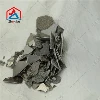
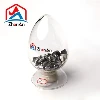
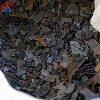
Finished material is delivered as ingots of various sizes or as blocks, blanks and pellets, depending on how the customer charges the ladle. Grade designations track the target element: ferrotungsten is commonly offered as FeW65, FeW70 and FeW70B, and ferromolybdenum as FeMo52, FeMo55, FeMo58 and FeMo60.
Ferrotungsten - high density and a very high melting point, used in tool steels and wear-resistant grades.
Ferromolybdenum - added to low-alloy and stainless heats for hardenability and high-temperature strength.
Size fractions - lump, granule and fine cuts so that dissolution matches melt shop practice.
Quality Control and Standards
Each heat is sampled after tapping and analysed by spectrometry, with the certificate issued against GB/T 3648 for ferrotungsten and GB/T 3649 for ferromolybdenum. Sulphur, phosphorus and non-metallic inclusion levels are checked because they carry straight into the steel that consumes the alloy. Segregation is controlled by crushing and re-blending, since a heavy alloy such as ferrotungsten can otherwise separate inside a single lot.
Packing, marking and lot traceability matter as much as analysis. Every drum or big bag carries the grade, the heat number and the size fraction, so a downstream failure can be traced back to the concentrate blend, the reductant batch and the furnace campaign that produced it.
Frequently Asked Questions
Q: What is the difference between an ore and a concentrate in ferroalloy production?
Ore is charged as mined when it is rich enough; a concentrate is beneficiated ore with a higher oxide content and a controlled gangue level, used when the raw ore is too lean.
Q: Which reducing agents are used?
Coal, coke, semi-coke and peat briquettes are the usual carbon sources, selected for reactivity and low ash so that the alloy stays within the phosphorus and sulphur limits.
Q: Why does the reductant also need to supply iron?
Iron is the carrier that dissolves the reduced element and takes it out of the reaction zone, which suppresses re-oxidation and yields an alloy with a high content of the wanted element.
Q: What grades of ferrotungsten and ferromolybdenum are available?
Ferrotungsten is normally supplied as FeW65, FeW70 and FeW70B, and ferromolybdenum as FeMo52, FeMo55, FeMo58 and FeMo60, each in defined size fractions.
Q: How is the finished alloy delivered?
As ingots of assorted sizes or as blocks, blanks and pellets, packed in drums or big bags with the grade, heat number and size fraction marked for traceability.