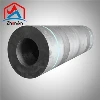

Applications of Molybdenum Crucibles
Molybdenum crucibles are mainly used in rare earth smelting, quartz glass smelting furnaces, high-temperature furnaces, induction furnaces, and high-temperature containers of sapphire furnaces. Because molybdenum has a high melting point, good high-temperature strength, and resistance to many molten materials, the crucible can withstand severe service conditions. At present, hot spinning molybdenum crucibles are widely used in sapphire crystal growth, where dimensional accuracy and high density are required.
Method 1: Sintering
The sintering method starts with molybdenum powder, which is cold-formed and then sintered at high temperature in a high-temperature sintering furnace. The sintered body achieves a density greater than 9.8 g/cm3. Sintering is suitable for producing crucibles with relatively simple geometry, and the density can be further improved through subsequent processing. The sintered blank provides a base for turning or other finishing operations.
Method 2: Turning
The turning method uses sintered molybdenum crucible blanks, sintered molybdenum rods, or forged molybdenum rods, which are formed on a lathe. The resulting products reach a density of 9.8 to 10.15 g/cm3. Turning allows good dimensional control and surface finish, which is important for crucibles that must fit precisely into furnace assemblies. The starting blank quality directly affects the final product, so the raw material density and internal structure should be verified before machining.
Method 3: Hot Spinning
The hot spinning method starts from a molybdenum plate or molybdenum tube blank. The appropriate plate or tube is selected and spun at high temperature to form the crucible shape, reaching a density of about 10.15 g/cm3. Hot spinning produces a fine-grained, high-density structure that gives excellent high-temperature performance, which is why this method is widely used for sapphire crystal growth crucibles. The process requires careful control of spinning temperature and feed rate to avoid cracking in the molybdenum blank.
Choosing a Processing Method
The choice of method depends on the required density, size, wall thickness, dimensional accuracy, and service conditions. Sintering is economical for standard sizes, turning provides good dimensional control, and hot spinning gives the highest density and best structure for demanding crystal growth applications. Buyers should specify the crucible dimensions, wall thickness, density requirement, and application so the supplier can select the appropriate process and verify quality after processing.
FAQ
Q: What are molybdenum crucibles used for?
A: They are used in rare earth smelting, quartz glass smelting, high-temperature furnaces, induction furnaces, and as high-temperature containers in sapphire furnaces.
Q: What density does the sintering method achieve?
A: Sintered molybdenum crucibles achieve a density greater than 9.8 g/cm3.
Q: What density does the turning method achieve?
A: Turned crucibles from sintered or forged blanks reach a density of about 9.8 to 10.15 g/cm3.
Q: Why is hot spinning used for sapphire crucibles?
A: Hot spinning produces a high-density fine-grained structure of about 10.15 g/cm3, which gives the high-temperature performance needed for sapphire crystal growth.
Q: How do the processing methods differ in cost?
A: Sintering is generally the more economical route for standard sizes, while turning adds dimensional control and hot spinning is the most demanding process with the highest density result.
Q: What should be specified when ordering a molybdenum crucible?
A: Dimensions, wall thickness, density requirement, application, and any tolerance requirements so the correct processing method and quality checks can be applied.