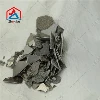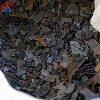
Refractory brick material refers to natural or artificially combined minerals or minerals used for making refractory materials with a fire resistance of over 1580 ℃. Common refractory materials mainly include: siliceous materials, paraffin materials, clay materials, high alumina materials, dolomite materials, magnesium materials, and others.
Siliceous materials: Siliceous refractory mineral materials primarily consist of silica. Silica is not a mineral title but an industrial term, and in the industry, block like siliceous materials are referred to as silica. Its primary mineral is crystalline stone, with the primary chemical composition being SiO2. Silica can be classified according to its structural density level, crystal transformation rate, and heating expansion level. Generally speaking, crystalline silica is relatively pure and dense, and can be used as a material for making bricks and preparing siliceous refractory concrete. Cemented silica is prone to loosening after burning due to its high content of impurities and is rarely utilized.
Wax stone material: commonly referred to as pyrophyllite, it is also called pyrophyllite. Most of the wax stone used in the industry is pyrophyllite, which is a dense massive ore associated with kaolinite, boehmite, crystal, chalcedony, mica and other minerals. Natural paraffin can be used to produce semi silica refractory products.
Clay material: Clay is not a simple mineral, but is composed of a diameter of less than 0.001mm (or less than 1-2 μ m) Assimilation of various hydrated aluminum silicate minerals. Its characteristics are plasticity in both wet and fine powder forms (obtained by assimilation after destruction and water addition), hardening after drying, and vitrification under sufficient high temperature heating. Clay can be divided into primary clay, secondary clay, and left-handed clay according to their growth conditions. The plasticity of clay can also be divided into soft clay and hard clay. It can be divided into kaolin, kaolinite clay and kaolinite clay rock according to sedimentary type.
High alumina materials: the materials for producing high alumina finished products can be divided into aluminosilicate minerals according to their main mineral phases, such as sillimanite, kyanite, andalusite and artificially combined mullite. Water bearing alumina minerals are bauxite, such as boehmite, boehmite and gibbsite. Anhydrous alumina materials, such as natural alumina, industrial alumina, fused alumina, etc. According to the main mineral composition, bauxite in this area can be separated into: (1) diaspore high alumina (D-K) type, (2) diaspore pyrophyllite (D-P) type; (3) Boehmite kaolinite type (B-K); (4) Hydroaluminite Ili stone (D-I) type; (5) Bauxite kaolinite rutile (D-K-R) type. Rongsheng Refractory produces and sells various types of refractory materials.
Magnesium materials and others: The primary material for producing magnesium refractory materials, magnesia, refers to sintered magnesia with necessary particle composition. It is formed by the rupture of sintered magnesia. Sintered magnesite can be obtained by calcining magnesite. In addition, sintered magnesite can also be extracted from the sea, salt lake brine, dolomite, serpentine and brucite. However, nowadays, sintered magnesite in China is still obtained by calcining natural magnesite, and the magnesium extraction project in salt lakes is being established.
Olivine minerals contain a mineral with consistent composition and belonging to the same orthorhombic system. The most common minerals in nature are forsterite and fayalite. However, only dunite with less iron or serpentinized dunite can be used as refractory materials.

May 14, 2023
Leave a message
How To Classify Commonly Used Refractory Materials And Raw Materials
Send Inquiry