
Why Cast Iron Is Inoculated Before Pouring
In a foundry, a controlled addition of inoculant is made to the molten iron shortly before pouring. The treatment changes the solidification path of the melt: it introduces and preserves heterogeneous nucleation sites so that graphite grows in a controlled, desirable form instead of the brittle carbide network that appears in a chilled or under-cooled casting. Because the effect is transient, timing, particle size and addition rate matter as much as the choice of alloy.
Inoculation is applied to both gray iron and ductile iron, but the objective differs. In gray iron the aim is Type A flake graphite, uniform through the section, with a matrix that meets the specified hardness. In ductile iron, inoculation follows the spheroidizing treatment in order to prevent chill, raise nodule count and nodularity, and suppress the associated spheroidization fading that can appear in heavy sections.
Core Functions of an Inoculant in Cast Iron
Strongly increases graphitization nuclei. A fine, well distributed population of nuclei refines the graphite, promotes Type A flake graphite in gray iron, and makes the graphite in ductile iron fine and round while improving the spheroidization level.
Reduces the under-cooling degree of the melt. Lower under-cooling favours graphite precipitation, cuts the tendency to white iron or chill, lowers relative hardness and improves the cutting performance of the casting.
Strong anti-fading ability. A barium-bearing inoculant holds its effect for about twice the time of 75% ferrosilicon while its addition weight is less than half that of a plain FeSi75 treatment, and it also limits spheroidization fading.
Low wall-thickness sensitivity. Response is retained in thin sections, so cross-section uniformity improves and shrinkage and porosity tendencies are reduced.
Stable chemistry and uniform grading. Consistent composition, a narrow screen fraction and small deviations from heat to heat keep results repeatable.
Low melting point. The alloy melts below roughly 1300 °C, is easily absorbed by the melt during treatment, and leaves very little scum on the bath surface.
Inoculant Types and Typical Chemistry
| Inoculant | Typical composition | Where it is used |
|---|---|---|
| FeSi75 ferrosilicon | Si 72–80%, balance Fe, low Al | General gray iron, thin sections, cost-driven work |
| Barium-bearing ferrosilicon | Si 60–70%, Ba 2–6%, Ca 0.5–2% | Long holding times, heavy sections, fading control |
| Calcium-bearing ferrosilicon | Si 65–75%, Ca 1–3% | Ductile iron, chill reduction |
| Rare-earth ferrosilicon | Si 45–60%, Ce plus La 2–7% | Ductile iron with tight residual magnesium control |
| Silicon carbide and graphite base | SiC 70–90%, or high-purity graphite | Preconditioning, carbon and silicon correction |
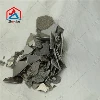
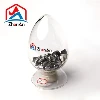
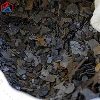
Screen size is matched to the treatment method. Fine grades of 0.2–1 mm suit in-stream or mould inoculation, while coarser grades of 2–5 mm are used for ladle addition. Chemistry is verified against the ferrosilicon specification GB/T 2272 for the base alloy, and each delivery should be checked for silicon, aluminium, moisture and screen analysis.
Correct Use Method
Weigh the inoculant against the iron weight and the target residual rather than by habit. Typical additions run 0.1–0.4% for gray iron and 0.3–0.6% for ductile iron after spheroidizing.
Treat at a suitable tapping temperature, normally 1380–1450 °C. Too cold and the alloy will not dissolve; too hot and fading accelerates.
Prefer late inoculation: place part of the addition in the ladle and part in the pouring stream or mould cavity, so the nuclei are released as close to solidification as possible.
Keep the addition dry and free from fines. Moisture causes gas defects, and dust losses bias recovery figures.
Stir gently and skim the dross before pouring. Extended skimming and long waiting times both consume the effect.
Control the base iron: high sulphur, high oxygen or excessive titanium and aluminium in the charge consume inoculant and flatten the response.
Verification and Troubleshooting
Three checks are normally used together. A wedge chill test evaluated to the graphite classification of ISO 945 or ASTM A247 shows whether the chill depth has been removed. Thermal analysis of the cooling curve gives the eutectic under-cooling and the recalescence value on the shop floor within seconds. Metallographic counting of nodule number, nodularity and graphite size confirms the final structure on a polished sample.
| Symptom | Likely cause | Action |
|---|---|---|
| Chill not removed | Under-dosing, coarse grade, cold melt | Raise addition, use finer grade, lift tapping temperature |
| Response varies between heats | Base iron chemistry drift, high S or O | Tighten charge control, precondition the melt |
| Nodularity falls in heavy sections | Fading after spheroidizing | Switch to a barium or rare-earth bearing grade, shorten holding time |
| Dross and scum on the bath | Wet or dusty inoculant, over-addition | Dry and screen the alloy, adjust the dosage |
FAQ
Q: How much inoculant should be added to cast iron?
Typical practice is 0.1–0.4% of the iron weight for gray iron and 0.3–0.6% for ductile iron after spheroidizing, split between ladle and stream addition. The exact figure is set by the chill test result and the base iron chemistry.
Q: Why does inoculation fade?
The nuclei coarsen, dissolve or are consumed by oxygen and sulphur in the melt. Fading accelerates with higher temperature, longer holding time and a dirtier base iron, which is why late inoculation is preferred.
Q: When is a barium-bearing inoculant worth the extra cost?
When the melt must be held for several minutes, when sections are heavy, or when nodularity must survive transport to the mould. Its longer effective duration reduces the total addition weight and the risk of spheroidization fading.
Q: Can inoculation replace spheroidizing treatment in ductile iron?
No. Spheroidizing supplies magnesium or a comparable element to change the graphite shape; inoculation only refines and stabilises nucleation afterwards. The two steps are complementary.
Q: What particle size is best?
Finer fractions dissolve faster and act sooner, so they suit stream and mould inoculation. Coarser fractions survive longer in the ladle. A mixed or graded size matched to the treatment point gives the most consistent recovery.