
What the Numbers 45 and 75 Mean
The two digits in ferrosilicon 45 and ferrosilicon 75 state the nominal silicon content of the alloy by weight. Ferrosilicon 45 (FeSi45) contains about 45% silicon with iron as the balance, while ferrosilicon 75 (FeSi75) contains about 75% silicon and only 20 to 25% iron. Almost every practical difference between the two grades - specific gravity, impurity load, energy consumed per tonne of contained silicon, price and the duties a steelmaker can assign - follows from that single figure.
Both grades are produced by the same reaction family: carbothermic reduction of silica (SiO2) in a submerged arc furnace, with iron supplied as mill scale, iron ore or clean steel scrap. Reaching 75% silicon, however, demands a purer quartz charge, closer electrode control and more electrical energy per tonne, which is why the higher grade carries a premium in the market.
Chemical Composition and Impurity Control
| Parameter | Ferrosilicon 45 | Ferrosilicon 75 |
|---|---|---|
| Nominal silicon (Si) | Approximately 45% | Approximately 75% |
| Iron (Fe) | Balance, roughly 53-55% | Balance, roughly 20-25% |
| Aluminium and calcium | Higher residuals, held to the agreed specification | Tighter control, typically Al below 1% and Ca below 1% |
| Common commercial sizing | 10-50 mm, 10-100 mm, 0-3 mm powder | 10-50 mm, 10-100 mm, 0-3 mm powder |
| Silicon delivered per tonne | About 450 kg | About 750 kg |
Because FeSi75 carries a smaller share of iron and tramp elements, it suits heats in which residual aluminium and calcium must be kept low, such as silicon-electrical steels, stainless grades and certain tool steels. FeSi45 accepts a wider impurity window, which is normally acceptable in general structural steelmaking and in cast iron treatment.
Grade definitions and delivery conditions are normally agreed against recognised ferrosilicon specifications such as GB/T 2272 and ISO 5445, with a certificate of analysis issued for each heat.
Density, Structure and Furnace Behaviour
Adding silicon lowers the specific gravity of the alloy, so FeSi45 is the heavier of the two materials and FeSi75 the lighter. That reversal matters during charging: FeSi45 penetrates a slag layer more readily, while FeSi75 tends to remain at the surface longer and needs a well-designed addition practice to avoid hold-up in the slag.
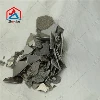
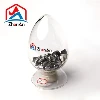
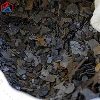
FeSi45 is normally supplied as grey granules or lumps with a slightly rougher fracture surface. FeSi75 is a darker grey, more compact lump with lower porosity. The higher silicon grade is also more reactive at the surface, so oxidation and fines generation during long storage are more likely.
Applications of Each Grade
FeSi45: general deoxidation in basic oxygen and electric furnace steelmaking, where the objective is to remove dissolved oxygen at the lowest cost per unit of silicon.
FeSi45: inoculation and graphitisation control in grey and ductile cast iron, improving wear resistance and machinability.
FeSi75: alloying and deoxidation in higher-grade steels, including electrical steels for transformers and motors and selected stainless and tool grades.
FeSi75: feedstock in magnesium ferrosilicon nodulisers and in silicon-based alloy production where a high silicon input is required.
Both: dense media and heavy concrete applications that use the specified specific gravity of the alloy.
Cost, Energy and Consumption Economics
FeSi45 is cheaper per tonne because it needs less energy and lower-grade raw materials. That advantage shrinks when it is measured per kilogram of silicon delivered: one tonne of FeSi75 supplies roughly 750 kg of silicon, while one tonne of FeSi45 supplies about 450 kg. Buyers comparing offers should therefore evaluate cost per unit of contained silicon rather than cost per tonne of alloy, and then add the extra handling, freight and slag volume that a larger addition of the lower grade creates.
Furnace productivity follows the same logic. A melt shop that switches from FeSi45 to FeSi75 for a demanding grade usually reduces the number of addition steps and the volume of slag-forming material, even though the alloy itself costs more per tonne.
Storage, Handling and Documentation
Both products should be stored under cover on a dry floor. FeSi45 is less prone to surface oxidation and tolerates ordinary warehouse conditions. FeSi75 is more sensitive to moisture and should be kept in sealed or well-covered packaging, particularly in powder or fine-grain form. A certificate of analysis covering Si, Fe, Al and Ca together with the sizing declaration is normally sufficient to close out a purchase specification.
Frequently Asked Questions
Q: Is ferrosilicon 75 always the better grade?
Not necessarily. FeSi75 delivers more silicon per tonne and lower residuals, but it costs more. For plain carbon steel deoxidation, FeSi45 usually gives the same metallurgical result at a lower cost per heat.
Q: How do I convert between FeSi45 and FeSi75 addition rates?
Compare contained silicon. If a heat needs 300 kg of silicon, that is about 667 kg of FeSi45 or about 400 kg of FeSi75. Confirm the actual assay on the certificate before finalising the charge calculation.
Q: Why is FeSi45 heavier than FeSi75?
Because silicon is lighter than iron. FeSi45 contains more iron and therefore has a higher specific gravity, which is why the two grades behave differently when they are added to a slag-covered bath.
Q: Can the two grades be mixed in one heat?
Yes. Some melt shops trim silicon with a small addition of FeSi75 after a bulk addition of FeSi45. The alloy dissolves completely, and the resulting recovery depends mainly on bath temperature and oxygen content rather than on the grade mix.
Q: What sizing should be ordered for a basic oxygen furnace?
Lump grades in the 10-50 mm range are the usual choice for charging and ladle additions. Powder grades of 0-3 mm suit briquette or injection systems, where a finer and more reactive product is required.
Q: How should samples be taken for analysis?
Take a representative sample from the crushed lump product rather than from the surface of the pile, because fines and dust segregate during handling. Sample preparation and silicon determination should follow the agreed standard method for ferrosilicon.