
What Silicon Metal Powder Is
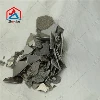
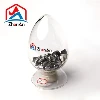
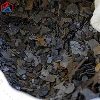
Silicon metal powder is produced by crushing, grinding and screening metallurgical grade silicon that has been smelted in a submerged arc furnace from quartz and a carbon reductant. The powder is graded both by particle size and by chemical composition, and it is supplied either as an unmilled granular product or as a finely ground powder for specialised duties. In metallurgy the powder form is preferred because it dissolves quickly and disperses evenly through the melt.
Grade designations follow the industrial silicon convention in which the digits record the maximum iron, aluminium and calcium content in hundredths of a percent. A 553 grade limits iron to 0.5%, aluminium to 0.5% and calcium to 0.3%, while a 2202 grade keeps all three impurities far lower. Impurity control is the main commercial variable, because iron, aluminium and calcium each influence recovery, slag behaviour and final steel cleanliness.
Deoxidation and Alloying in Ferroalloy Production
Silicon has a strong affinity for oxygen, and this is the property that makes silicon metal powder a standard deoxidiser. When the powder is added to a melt, it reacts with dissolved oxygen and forms silica, which is absorbed by the slag and removed from the bath. The result is a lower oxygen content, fewer oxide inclusions and better mechanical properties in the finished alloy.
Acting as a deoxidiser in ferroalloy melting, where it lowers the oxygen content of the alloy and improves purity
Serving as an alloy additive in the production of ferrosilicon and other silicon-bearing master alloys
Working as a reducing agent in silicothermic processes, where the oxidation of silicon supplies the heat and the driving force for reducing other oxides
Adjusting silicon content in special alloys to reach a specified analysis without disturbing other elements
Recovery depends on particle size, addition method and slag conditions. Coarse granular material dissolves more slowly but suffers less loss to the slag, while fine powder reacts faster and therefore needs a controlled addition technique.
Use in Stainless and Special Steels
Stainless steel relies on chromium for corrosion resistance, and silicon supports that performance in several ways:
Corrosion and oxidation resistance: silicon improves the resistance of the steel surface to oxidation and to several aggressive media, which extends service life in high-temperature and chemical environments.
Mechanical properties: controlled silicon additions raise hardness and strength and improve high-temperature stability of the alloy structure.
Structure control: silicon is a ferrite stabiliser and influences grain growth and phase balance, so the addition is used to tune the final microstructure.
Electrical steels: in silicon-bearing electrical steels the element raises electrical resistivity and reduces core loss, which is the basis of its use in transformer and motor laminations.
Silicon is not beneficial in unlimited amounts, because excessive levels can reduce ductility and toughness. The target analysis, not the maximum possible addition, therefore governs the charge calculation.
Foundry and Casting Applications
In the foundry the same material is used as an additive for molten iron and steel, and the effect is mainly on structure and casting quality:
Improving the fluidity of the melt so that thin sections fill completely and surface defects are reduced
Acting as a filler and reinforcing additive that supports the structure of the casting as it solidifies
Refining the structure of the casting so that hardness, strength and wear resistance are more uniform
Reducing the tendency to chill and to thermally induced cracking in thin or complex sections
Because the addition is small relative to the charge, weighing accuracy and even distribution matter more than the absolute quantity added.
Grades and Typical Specifications
| Grade | Fe, max | Al, max | Ca, max | Typical use |
|---|---|---|---|---|
| 2202 | 0.2% | 0.2% | 0.02% | high purity alloying and special steels |
| 3303 | 0.3% | 0.3% | 0.03% | stainless and alloy steel melting |
| 441 | 0.4% | 0.4% | 0.1% | general deoxidation and alloying |
| 553 | 0.5% | 0.5% | 0.3% | foundry and bulk deoxidation |
Powder is supplied in standard size bands such as 0 to 1 mm, 0 to 3 mm, 3 to 10 mm and fine grades below 200 mesh, and chemical composition is normally declared with reference to the industrial silicon standard GB/T 2881. Size distribution is agreed with the customer because it controls dissolution rate and handling losses.
Frequently Asked Questions
Q: Why is silicon metal powder used instead of lump silicon?
Powder dissolves faster and distributes more evenly through the melt, which shortens the treatment time and improves recovery in small additions. Coarse lumps are used where slower, more controlled dissolution is preferred or where dust losses must be avoided.
Q: Which grade is suitable for stainless steel melting?
Grades such as 3303 or 441 are common for stainless and alloy steel heats, because iron and aluminium limits are low enough to protect steel cleanliness while the material remains cost effective. Higher purity grades are reserved for critical analyses.
Q: Does silicon metal powder work as a deoxidiser in all steels?
It is effective in most steels, but the reaction product is silica, which must be removed by a suitable slag. In steels where silica-rich inclusions are undesirable, the deoxidation sequence must be planned so that the inclusions are modified or floated out.
Q: What is the effect of moisture in the powder?
Moisture and fines increase handling loss through dusting and can introduce hydrogen into the melt. The powder should be stored dry and added only after the charge calculations have been verified.
Q: How is the addition rate determined?
It follows a simple mass balance: the target silicon content, the silicon already present in the charge and the expected recovery are used together to calculate the addition. Recovery should be reviewed against production data rather than assumed.
Q: Are there applications outside metallurgy?
Yes. Fine grades are also used in the production of solar-grade silicon feedstock, in the manufacture of silicon-based chemical intermediates and in certain magnetic and nano-scale materials, where purity requirements are much stricter than in steelmaking.