
What Ferro Silicon Nitride Is
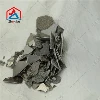
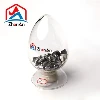
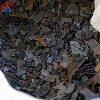
Ferro silicon nitride is a composite refractory raw material in which silicon nitride (Si3N4) is the main phase and metallic iron is dispersed through the material. Typical commercial material contains about 75-80% silicon nitride and about 12-17% free iron, the balance being minor phases and residual impurities. It is supplied as a granulated or powdered product, and unlike many refractory raw materials it is not an entirely brittle ceramic: the iron phase gives it a certain toughness, and the material has become a standard additive for taphole and trough mixes.
The combination of phases is what makes it useful. Silicon nitride contributes high refractoriness, resistance to thermal shock and good chemical resistance, while the free iron content improves wetting and bonding in clay bonded and resin bonded systems and helps the mix behave consistently when it is placed in the taphole.
Key Properties
Low coefficient of thermal expansion compared with oxide-based aggregates, which reduces cracking under rapid temperature change.
Good thermal conductivity, which helps spread heat and reduces hot spots in the lining.
Resistance to cracking, to erosion and to chemical attack from slag and molten metal.
Good mechanical strength at both room temperature and service temperature.
Low flow value, so the material stays where it is placed instead of running out of the taphole or trough.
Ready dispersion and easy shaping, which is why it can be moulded into the opening of the taphole region.
| Parameter | Typical range |
|---|---|
| Silicon nitride content | 75-80% |
| Free iron content | 12-17% |
| Form | Granular or powder |
| Main application | Taphole and trough mixes for blast furnaces |
The values above describe the usual commercial range. Actual figures are stated for each batch, and users should not assume one fixed composition for every delivery.
Use in Blast Furnace Tapholes and Troughs
The principal application is the taphole and trough area of the blast furnace, where the lining has to survive repeated tapping cycles. Trough and taphole mixes based on ferro silicon nitride protect the lining around the tapping hole and form a working surface that holds its shape during tapping.
In service the material is credited with stabilising both the tapping time and the depth of the taphole. Because the working lining keeps a consistent profile, the operator can hold a steady tapping schedule and avoid the swings in tapping time and hole depth that follow irregular lining wear. That consistency is valuable in a furnace that must work efficiently in an environment of high temperature, high tapping rates and severe mechanical and chemical wear.
Other Applications
Additive in steelmaking, where the material is used as a source of nitrogen and of silicon in certain steel grades.
Raw material for abrasives and related products, where the hard silicon nitride phase contributes wear resistance.
Component of carbon and clay based taphole mixes, blended with synthetic clay or resin clay.
Compared with mixes made from synthetic clay alone or resin clay alone, a blend based on ferro silicon nitride offers a different balance of properties, which is why it is selected for demanding tapholes rather than used as a universal replacement. The choice between systems depends on furnace size, tapping practice and the lining life expected.
Handling, Storage and Batch Control
The material should be stored in dry, covered conditions to prevent moisture pickup, since a damp additive changes the water demand of a taphole mix and can affect placement and curing. Batch control is normally done by weight, and mixing should produce a uniform blend before the material is placed. Because the product is supplied in several grades, the nitrogen content and the free iron content should be confirmed from the delivery documents and, where required, by analysis of a sample taken from the batch.
Frequently Asked Questions
Q: What is ferro silicon nitride made of?
It is a composite material based on silicon nitride with dispersed free iron, typically containing about 75-80% silicon nitride and 12-17% iron.
Q: Why is ferro silicon nitride used in blast furnace tapholes?
It protects the lining around the tap hole, resists thermal shock and slag attack, and helps keep the tapping time and hole depth steady from one cast to the next.
Q: How does it differ from clay based taphole mixes?
Mixes based on ferro silicon nitride offer a different balance of refractoriness, strength and resistance to chemical attack than synthetic clay or resin clay mixes, so they suit demanding tapping conditions.
Q: Is ferro silicon nitride supplied as powder or as lumps?
It is normally supplied as a granulated or powdered material in grades defined by nitrogen and free iron content, and it is blended into the taphole or trough mix before use.
Q: What should be checked when the material arrives?
Check the nitrogen and free iron content stated for the batch, the particle size grading and the moisture condition, and keep the material dry until it is mixed.
Q: Can it be used outside ironmaking?
Yes. It is also used as an additive in steelmaking and in the manufacture of abrasives, where its hardness and nitrogen content are of value.