
What Is Cored Wire?
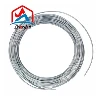
Cored wire is a continuous length of thin steel strip formed into a tube and filled with alloy powder or a reactive powder mixture. The steel sheath acts as the carrier and dissolves in the melt, while the powder provides the active element. Because the filler sits inside a steel tube, the addition can be pushed below the surface of liquid steel instead of being thrown onto it, which is why cored wire is used so widely in secondary metallurgy. Coils of wire are compact and easy to store, and the addition rate can be adjusted simply by changing the feeding speed.
How Cored Wire Is Made
| Element | Typical construction | Function |
|---|---|---|
| Sheath | Low-carbon steel strip, commonly 0.3 to 0.5 mm thick | Carries the filler into the melt and dissolves, releasing the powder below the bath surface |
| Core | Granular alloy or reactive powder, typically 50% to 65% of the wire weight | Provides the active element for deoxidation, desulfurisation, inclusion modification or alloying |
| Form | Seam-closed or interlocked tube, coiled for feeding | Protects the powder from moisture and mechanical loss during handling |
| Diameter | Commonly 9 to 13 mm depending on the ladle and feeder | Sets how much filler is delivered per metre of wire |
Manufacturing starts with a flat strip that is progressively rolled into a U-shape, filled with powder at a controlled rate, closed into a tube and then reduced to the final diameter. Fill ratio, powder granulometry and sheath thickness are all held within tight limits, because they decide how much active element reaches the steel per metre of wire fed.
Common Types of Cored Wire
Calcium silicon wire. The most widely used type, for calcium treatment that deoxidises, desulfurises and modifies alumina inclusions into liquid calcium aluminates.
Calcium silicon manganese wire. Combines calcium treatment with a manganese addition in one operation.
Calcium silicon barium wire. The barium addition improves the stability of the treatment and the recovery of calcium in some steel grades.
Barium aluminium and calcium aluminium wire. Used where aluminium is required together with calcium for inclusion control and grain refinement.
Calcium iron wire. A lower-cost calcium carrier for treatments where a high calcium recovery is not the primary aim.
Pure calcium wire. Used for trim calcium additions and for steels that must avoid silicon pickup.
Alloying wires. Powder fillers such as ferro boron, ferro titanium and carbon are used to make precise, late additions of alloying elements.
Applications in Ladle Metallurgy
Cored wire treatment is normally carried out during secondary metallurgy, after the heat has been tapped and while the steel is still in the ladle. Its main tasks are:
Deoxidation. Reactive elements remove residual oxygen and let the reaction products float into the slag.
Desulfurisation. Calcium and magnesium treatments lower sulphur content and improve the isotropy of mechanical properties.
Inclusion modification. Solid alumina inclusions are converted into liquid calcium aluminates that stay globular and do not clog submerged entry nozzles.
Alloying with special elements. Boron, titanium, niobium and carbon can be added with high accuracy close to the end of the process.
Process control. Feeding speed, wire length and treatment sequence can be logged and repeated, which makes the treatment reproducible from heat to heat.
Feeding Practice and Handling
Wire speed and depth. The feeder drives the wire through a guide tube so that the reaction takes place well below the surface, which raises recovery and reduces fume.
Ladle size. Larger ladles take a larger wire diameter and a higher feed rate so that the same amount of active element is delivered per tonne of steel.
Wire tension. Coils should unwind without kinking. Excess tension breaks the sheath and causes powder loss before the wire enters the melt.
Storage. Keep coils dry and off the floor. Damp powder fillers can react on contact with liquid steel and give erratic results.
Quality control. Check sheath thickness, fill ratio, wire diameter and powder chemistry for each lot so that treatment results stay predictable.
The word cored wire is also used in the textile industry for a yarn built around a filament core, which is a completely different product. In metallurgy the term always refers to a steel tube filled with powder.
Frequently Asked Questions
Q: What is cored wire made of?
A cored wire is a continuous length of low-carbon steel strip formed into a tube and filled with alloy or reactive powder. The strip acts as the carrier and the powder provides the active element.
Q: What types of cored wire are used in steelmaking?
Calcium silicon, calcium silicon manganese, calcium silicon barium, barium aluminium, calcium aluminium, calcium iron and pure calcium are the common types, together with alloying wires filled with ferro boron, ferro titanium or carbon.
Q: Why is calcium added with a cored wire rather than by hand?
Calcium has a low boiling point and low solubility in steel. Feeding it inside a steel sheath delivers it below the bath surface, so the element dissolves and reacts instead of burning away at the surface.
Q: What does a cored wire treatment achieve?
Depending on the filler, the treatment deoxidises, desulfurises or modifies non-metallic inclusions, and it can also add alloying elements such as boron or titanium in a controlled way.
Q: How is the wire fed into the ladle?
The wire is pulled from a coil by a feeding machine and injected through a guide tube into the molten steel at a controlled speed, with the depth and speed set by the ladle size and the treatment aim.
Q: What is the difference between metallurgical cored wire and textile core yarn?
They are unrelated products. Metallurgical cored wire is a steel tube filled with powder for melt treatment, while textile core yarn is a sewing or fancy yarn built around a filament core.