

What Is Cored Wire and Why Use It?
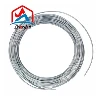
Cored wire is made by forming a steel strip around a powdered or granular alloy core. Common core materials include CaSi, CaFe, SiCaBa and other ferroalloys. During ladle treatment the wire is fed into molten steel to introduce the core material below the slag layer for calcium treatment, deoxidation, inclusion modification or alloy adjustment. Compared with adding bulk alloy at the surface, cored wire allows the alloy to be delivered below or closer to the slag-metal interface, reduces direct exposure of reactive material to slag and atmosphere, and controls the addition quantity by feeding length. This is particularly useful for reactive elements such as calcium, where recovery depends on introducing the element deep in the bath. Actual metallurgical recovery depends on wire quality, feeding practice and bath conditions.
Why Cored Wire Flattens or Breaks at the Feeder
If cored wire is flattened, slips or breaks while passing through the feeder, the problem may come from either the wire itself or the feeding equipment. Common causes include empty or under-filled sections of the core, loose wrapping or powder leakage, poor wire roundness or insufficient internal support, poor steel-strip quality or weak seam formation, and excessive wear or improper adjustment of the feeder rolls. When the problem appears repeatedly with one coil or batch, the wire diameter, roundness, seam condition and core filling should be inspected first before repeatedly changing feeder settings.
Why Cored Wire Scatters or Bursts Above the Melt
If the wire opens or releases the core before reaching the intended depth, part of the alloy can react near the slag layer instead of entering the steel effectively. Possible causes include feeding conditions that do not match the wire specification, shallow or unstable wire entry, loose wrapping or weak seam quality, damaged or deformed wire, and a mismatch between the steel sheath, bath condition and required release depth. The feeding speed should therefore be adjusted according to the wire diameter, steel sheath, core material, molten-steel temperature and ladle conditions rather than using one fixed value for every cored wire.
Incoming Inspection and Quality Control
Incoming inspection should focus on the properties that change dosing accuracy and feeding stability. Check the core fill weight per metre, because if the fill weight changes, the same feeding length introduces a different quantity of alloy even when the core chemistry is unchanged. The theoretical active-element addition can be estimated as core fill weight per metre multiplied by the active-element fraction; this value is theoretical and does not include metallurgical recovery. Inspect several positions along the coil for flattening, irregular diameter, open seams, powder leakage and sharp bends, because a wire can meet its chemical specification but still feed poorly if it is mechanically unstable. The certificate of analysis should show the actual core chemistry and be traceable to the supplied batch or coil.
Storage and Handling
Cored wire should be stored in a dry, ventilated warehouse and protected from rain, condensation and direct contact with wet floors. Recommended practices include keeping coils off the floor, keeping the original packaging closed until use, avoiding crushing or deformation of coils during stacking, separating different grades and batches where traceability is required, and inspecting wet or damaged coils before feeding. Moisture can cause some core materials to cake or deteriorate and may reduce feeding stability, and storage requirements should also follow the safety data sheet for the specific core material.
Core Particle Size and Wire Specification
The particle-size distribution of the core affects how uniformly the wire can be filled and how the material behaves after release into the molten steel. If particles are too coarse, packing may become uneven and segregation can occur; if the core contains excessive fine powder, leakage through weak seams and dust generation may increase. The correct range depends on the core material, wire diameter and manufacturing design, so particle size should be agreed as part of the finished-wire specification. A complete specification should state the core type, core chemistry, wire diameter, core fill weight per metre, core particle-size range, steel-strip thickness, coil weight and dimensions, and batch COA. There is no single specification for every cored wire, and common commercial wire diameters can include 9 mm, 10 mm and 13 mm, with steel-strip thickness often around 0.3 to 0.5 mm depending on the product.
FAQ
Q: Why does cored wire flatten or break at the feeder?
A: Common causes are under-filled core sections, loose wrapping, poor roundness, weak seam quality and feeder roll wear or adjustment; inspect the wire first before changing feeder settings.
Q: Why does cored wire burst above the molten steel?
A: The wire may open early because feeding speed does not match the wire and bath conditions, entry is shallow, or the seam and wrapping are weak, so the alloy reacts near the slag layer instead of entering the steel.
Q: What should be checked when cored wire arrives?
A: Check the core fill weight per metre, wire geometry and seam quality along the coil, and the batch chemistry traceability on the certificate of analysis.
Q: How should cored wire be stored?
A: Store in a dry, ventilated warehouse, keep coils off the floor, keep packaging closed until use, avoid crushing coils, and separate grades and batches where traceability is required.
Q: Why does core particle size matter?
A: It affects filling uniformity and release behavior: coarse particles can segregate, while excessive fines increase leakage and dust, so the range should be part of the wire specification.
Q: What is a typical cored wire specification?
A: It normally states core type, core chemistry, diameter, fill weight per metre, particle-size range, strip thickness, coil weight and batch COA; common diameters include 9, 10 and 13 mm.