
Why Ferrotitanium Is Added to Molten Steel
Ferrotitanium (FeTi) is an iron-titanium ferroalloy that is charged to the ladle, tundish or mould during steel refining. Its main job is deoxidation. Titanium has a higher affinity for oxygen than silicon or manganese, so an FeTi addition removes the dissolved oxygen that a conventional Si-Mn deoxidation leaves behind. At the same time titanium combines with dissolved nitrogen, which reduces the risk of porosity and strain ageing in the finished product.
Ferrotitanium is also a strong carbide and nitride former. In microalloyed, interstitial-free and grain-refined grades a controlled titanium addition fixes nitrogen as TiN and pins austenite grain boundaries during reheating. The result is cleaner steel, a finer and more uniform grain structure, and more reproducible mechanical properties through the section.
Deoxidation and Nitride-Forming Reactions
When ferrotitanium is added to liquid steel, titanium passes through a sequence of oxide stages instead of forming a single oxide at once:
Progressive oxide formation - titanium first forms Ti-rich oxides such as TiO and Ti2O3, then Ti3O5, before the final TiO2-rich phase reports to the slag.
Nitride formation - Ti + N gives TiN. TiN is stable at solidification temperatures and is the phase responsible for grain-boundary pinning in titanium-treated steels.
Carbide formation - Ti + C gives TiC. Titanium carbides contribute to the wear resistance of tool steels and to the elevated-temperature strength of titanium-stabilised grades.
Inclusion modification - fine titanium-bearing oxide particles act as nucleation sites that help residual inclusions float out into the slag.
Because titanium reacts with oxygen, nitrogen and carbon at the same time, the addition has to be balanced against the analysis target. An over-addition leaves hard TiN clusters that impair machinability and surface quality, while an under-addition leaves the nitrogen and oxygen targets unmet and the grain structure coarse.
Ferrotitanium Grades and Typical Specifications
Ferrotitanium is supplied in three commercial families. The table values are typical commercial ranges; grade designations, aluminium limits and trace-element maxima follow the applicable standard or an agreed purchase specification.
| Grade | Ti (%) | Al max (%) | Si max (%) | C max (%) | Typical use |
|---|---|---|---|---|---|
| FeTi30 | 25.0-35.0 | 8.0 | 4.0 | 0.10 | General steel deoxidation |
| FeTi40 | 35.0-45.0 | 8.0 | 4.0 | 0.10 | Alloy steels and cast irons |
| FeTi70 | 65.0-75.0 | 5.0 | 1.0 | 0.20 | Stainless and titanium-stabilised grades |
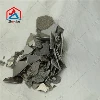
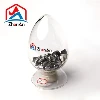
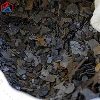
Lump ferrotitanium is normally screened to 10-50 mm for furnace and ladle additions. Crushed and graded material of 0-2 mm and 0-3 mm is used where fast, complete dissolution is required, for example in welding consumables and cored wire.
Applications in Steel and Alloy Production
Tool steels - titanium additions refine the as-cast structure and improve wear behaviour in cold-work and hot-work grades.
Stainless steels - titanium-stabilised austenitic grades rely on titanium to fix carbon and so prevent intergranular corrosion after welding.
Microalloyed and interstitial-free steels - titanium fixes nitrogen and sulphur and protects the formability of interstitial-free sheet.
Welding consumables - crushed FeTi is a standard ingredient in electrode coatings and flux-cored wires, where it controls oxygen and stabilises the arc.
Cast irons and wear-resistant alloys - titanium refines graphite morphology and improves the performance of abrasion-resistant castings.
Addition Practice and Recovery
Ferrotitanium is usually added to the ladle after primary deoxidation with aluminium or silicon, and before or during alloy trimming. Recovery is governed by several interlocking factors:
the oxidation state of the slag and the level of residual oxygen in the bath;
the point of addition relative to the deoxidation sequence;
particle size and the dissolution rate of the ferroalloy;
holding time and the extent of gas stirring after the addition.
A dense, low-oxygen slag and a short holding time both raise recovery and reduce scatter between heats. Titanium is easily reoxidised, so the analysis sample should be taken after complete dissolution and, where practice allows, before the final argon rinse. Keeping FeTi dry before charging also matters, because damp alloy introduces hydrogen and causes erratic dissolution.
For welding-grade material the crushed fraction is normally dried, screened and packed in moisture-resistant units so that the coating mix stays free of lumps and the deposit chemistry remains within specification.
Frequently Asked Questions
Q: Why use ferrotitanium rather than ferrosilicon for deoxidation?
Titanium has a stronger affinity for oxygen than silicon or manganese, so it removes the residual oxygen that Si-Mn deoxidation cannot reach and simultaneously fixes dissolved nitrogen.
Q: Which ferrotitanium grade should be selected for stainless steel?
FeTi70 is normally chosen for stainless and titanium-stabilised grades because its higher titanium content and lower silicon allow a precise addition with less slag volume.
Q: What particle size is used for welding consumables?
Crushed and screened fractions in the 0-2 mm and 0-3 mm range are standard for electrode coatings and flux-cored wires, where rapid and complete dissolution is required.
Q: How is titanium recovery improved in the ladle?
Add FeTi after aluminium or silicon deoxidation, keep the slag low in oxidising components, screen the alloy to a suitable size and shorten the holding time before casting.
Q: Does titanium cause defects in the finished steel?
Not when the addition is controlled. Excess titanium forms coarse TiN clusters that can affect machinability and surface quality, so the addition is normally balanced against the nitrogen and oxygen content of the heat.
Q: Is ferrotitanium suitable for interstitial-free sheet steel?
Yes. Titanium is a standard stabilising element for interstitial-free grades because it fixes carbon, nitrogen and sulphur, which keeps the deep-drawing properties of the sheet consistent.