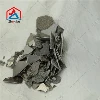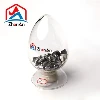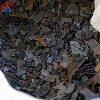

Ferro silicon 65, ferro vanadium 60 and silicon metal 3303 are often quoted side by side because they all supply a metallurgically active element to the melt, yet they behave quite differently in the ladle and belong to different parts of the steel and chemical value chain. This comparison sets out what each material is, how the grade numbers are read, and how to decide which one a given heat actually needs.
Overview of the Three Alloys
Ferro silicon 65 is an iron-silicon alloy carrying about two thirds silicon. It is a bulk addition, used in tonnage quantities for deoxidation and alloying, and its value lies in cheap, predictable silicon delivery. Ferro vanadium 60 is a much leaner addition by weight: vanadium is a powerful strengthening element, so small, precisely controlled additions produce a large change in steel properties. Silicon metal 3303 sits outside steelmaking entirely as a chemical and metallurgical feedstock of high-purity silicon, feeding the silicone, aluminium and photovoltaic industries. In other words, the first two are additions to steel, while the third is a raw material from which other silicon products are made.
Chemistry and Specifications
| Product | Standard | Main element | Typical chemistry | Impurity limits |
|---|---|---|---|---|
| Ferro silicon 65 | GB/T 2272 | Silicon | Si 65.0–70.0%, Fe balance | Al ≤2.0%, Ca ≤0.5% |
| Ferro vanadium 60 | GB/T 4139 | Vanadium | V 58.0–65.0% typical, Fe balance | Si ≤2.0%, Al ≤2.5%, C ≤0.06%, P ≤0.05%, S ≤0.05% |
| Silicon metal 3303 | GB/T 2881 | Silicon | Si about 99.3% minimum, balance trace elements | Fe ≤0.3%, Al ≤0.3%, Ca ≤0.03% |
The four-digit grade code used for silicon metal is worth reading carefully. In 3303, each digit pair states a maximum impurity level: iron 0.3%, aluminium 0.3% and calcium 0.03%. Subtracting those maxima from 100 leaves roughly 99.3% silicon, which is why the grade is a chemical-grade material rather than an electronic-grade one – semiconductor and solar applications need purity several orders of magnitude higher and are supplied from completely different grades. Ferro silicon 65 and ferro vanadium 60 are graded by their alloying element content, with aluminium, calcium, carbon, phosphorus and sulphur limits set for each grade by the corresponding standard.
Functional Differences in Steelmaking
Ferro silicon 65 – deoxidation and silicon alloying. Silicon has a high affinity for oxygen, so FeSi65 is charged to kill the bath before casting and to reach the silicon level required by electrical, spring and transformer steels. In foundry work it improves the fluidity of molten iron and promotes graphite formation, and it is also the silicon carrier in magnesium ferrosilicon treatment for ductile iron.
Ferro vanadium 60 – strengthening at very low addition rates. Vanadium forms stable nitrides and carbides that pin grain boundaries and raise yield strength, toughness and wear resistance. Because a few hundred grams per ton can shift mechanical properties appreciably, vanadium is dosed with care, usually in the ladle or during tapping.
Silicon metal 3303 – chemical feedstock, not a steel additive. This material is the starting point for silicone intermediates, silicon-containing aluminium alloys and other chemical products, and it is valued for consistent impurity levels rather than for reactivity in a steel bath.
Selection Guidance by Application
| Requirement | Ferro silicon 65 | Ferro vanadium 60 | Silicon metal 3303 |
|---|---|---|---|
| Primary role | Deoxidiser and silicon alloy | Micro-alloying for strength | Chemical and metallurgical feedstock |
| Typical addition | Tonnage scale | Small, tightly controlled | Not added to steel |
| Main industries | Steelmaking, foundries, ductile iron | High-strength construction, automotive, machinery | Silicones, aluminium alloys, chemicals |
| Key buying criterion | Silicon content, aluminium and calcium limits | Vanadium content, carbon and phosphorus limits | Impurity profile and consistency |
The decision usually follows the specification rather than preference. If the heat needs oxygen removed and silicon set to a level, ferro silicon 65 is the economical answer. If the specification calls for a strength level that only micro-alloying can reach, ferro vanadium 60 provides it with minimal addition weight and minimal disturbance to the carbon balance. If the end product is a silicone, an aluminium alloy or a chemical intermediate, silicon metal 3303 is the feedstock, and alloy chemistry is not the deciding factor.
Quality Control, Sizing and Packaging
Sampling and testing. Each order passes more than four checks by spectrometer and wet chemical analysis, covering incoming raw material, the molten or reduction stage, particle size screening and the pre-shipment sample.
Size fractions. All three products are graded by size – lump for furnace or ladle charging, finer fractions for injection or briquetting – and the chosen fraction should match the charging method rather than being left to the supplier.
Packaging. Waterproof plastic woven bags are standard, with 10 kg or 25 kg bags inside 1 MT bulk bags, or custom packing to suit the handling system.
Segregation. The three materials must be stored separately. Silicon metal in particular is judged on trace impurity levels, and cross-contamination with a ferroalloy will show up directly in the analysis.
Documentation. Lot-level analysis certificates should travel with the material so the receiving inspection can be reconciled against the ordered grade.
Frequently Asked Questions
Q: Are ferro silicon 65, ferro vanadium 60 and silicon metal 3303 interchangeable?
No. Ferro silicon 65 and ferro vanadium 60 are additions to liquid steel that deliver silicon and vanadium respectively, while silicon metal 3303 is a high-purity chemical feedstock used outside steelmaking.
Q: How do I read a silicon metal grade such as 3303?
The digits give maximum iron, aluminium and calcium levels in tenths and hundredths of a percent, so 3303 means iron 0.3%, aluminium 0.3% and calcium 0.03%, leaving roughly 99.3% silicon.
Q: Which standard covers each product?
Ferro silicon is covered by GB/T 2272, ferro vanadium by GB/T 4139 and silicon metal by GB/T 2881, each setting grade designations and chemical requirements.
Q: Why is ferro vanadium used in such small quantities?
Vanadium forms very stable carbides and nitrides, so a small addition produces a large change in strength, toughness and wear resistance, and overdosing would waste alloy and distort the specification.
Q: Can silicon metal 3303 be used to deoxidise steel?
It contains silicon and would technically react with oxygen, but it is far more expensive per unit of silicon than ferro silicon and is normally reserved for applications that need its low impurity levels.
Q: What should be checked on receipt?
Confirm the lot analysis against the ordered grade, verify the size fraction, inspect packaging for moisture damage and keep the three materials segregated to prevent cross-contamination.