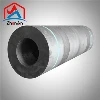

Magnesia carbon bricks are the workhorse lining material of modern oxygen and electric steelmaking vessels, and their thermal behaviour decides how much energy a furnace loses through its walls every heat. A brick that spreads heat evenly into the shell, keeps its shape at 1650 °C and still resists slag attack allows operators to shorten tap-to-tap times, trim burner and electrode input, and hold ladles hotter between casts.
How Magnesia Carbon Bricks Reduce Energy Loss
Controlled thermal conductivity. The graphite network in an MgO-C brick carries heat away from the hot face instead of letting it concentrate and spall the lining, so the shell stays within its design temperature and the vessel can be run harder without extra cooling water or shell fans.
Low thermal expansion and high thermal shock resistance. Graphite absorbs the expansion mismatch between magnesia grains and the matrix, so the brick survives rapid heating and cooling cycles. Fewer emergency repairs mean fewer cold restarts, and a cold restart is the single most energy-intensive event in a steel plant.
Thin, stable working lining. Because MgO-C bricks keep their strength at temperature, a thinner lining does the same job as a heavy monolithic or fireclay lining. Less refractory mass means less heat stored in the wall, so more of the process heat reaches the melt.
Better slag resistance. High-purity magnesia with a graphite-rich matrix resists basic slag penetration and reduces the joint erosion that opens heat paths into the shell.
The practical result is a lining that loses less heat to the environment, needs fewer repairs and keeps its dimensions through a full campaign, which is exactly what "enhanced energy efficiency" means on a furnace floor.
Typical Specification Range
| Property | Typical range | Test reference |
|---|---|---|
| MgO content | 72–85% (fused or co-clinker magnesia) | Chemical analysis |
| Carbon content | 8–20% graphitic carbon | Chemical analysis |
| Bulk density | ≥2.90–3.05 g/cm³ | GB/T 2997 |
| Apparent porosity | ≤4–6% | GB/T 2997 |
| Cold crushing strength | ≥35–45 MPa | GB/T 5072 |
| Refractoriness under load (0.2 MPa) | ≥1600–1650 °C | Differential rising-temperature method |
| Standard coverage | Dimensions and technical requirements | GB/T 22589 |
Values inside these bands are chosen per vessel: a converter working lining leans toward higher carbon for slag resistance, while a ladle or tundish lining often uses a lower-carbon, higher-density brick where steel cleanliness and low carbon pick-up matter more than raw heat transfer. Bulk density and apparent porosity are measured to GB/T 2997 and cold crushing strength to GB/T 5072, so incoming and outgoing test data stay comparable across lots.
Applications Across High-Temperature Industries
Steelmaking. Electric arc furnace hot spots and slag lines, basic oxygen converter linings, ladle working linings and tundishes, where the brick controls heat transfer into the melt and limits skull build-up.
Non-ferrous smelting. Aluminium, copper and nickel furnaces use MgO-C bricks where a basic lining has to survive metal and slag contact at temperature.
Glass and ceramics. Glass melting furnaces and ceramic kilns use the brick's thermal conductivity and heat retention to keep the crown and sidewalls uniform.
Petrochemical. Reformers, cracking furnaces and gasifiers use MgO-C in high-temperature zones where a stable, insulating hot face lowers fuel demand and lengthens turnaround intervals.
Selection, Installation and Operating Notes
Energy performance is decided as much by brick laying as by brick chemistry. Joints should be kept to 1–2 mm and filled with a matching magnesia-carbon mortar or dry mix, because an open joint becomes a hot-gas channel that both leaks heat and erodes the brick edge. Expansion allowance is normally provided with cardboard or a compressible insert at the ends of a course rather than by widening joints.
The heat-up curve is the second lever. Free and chemically bound water must be driven off slowly below 600 °C; a fast ramp traps steam behind the hot face and causes spalling that shows up as shell hot spots weeks later. Once in service, keeping the ladle or furnace on a steady rotation, avoiding long idle periods and maintaining a consistent slag basicity all extend lining life and preserve the energy advantage the brick was selected for.
Quality Control
Production control starts with incoming magnesia and graphite, continues through mixing, pressing and curing, and finishes with a fired or resin-bonded check before packing. Bulk density, apparent porosity, cold crushing strength and carbon content are recorded per batch, and dimensions are gauged against the drawing tolerance. Every order is inspected at least four times – raw material, in-process mix and forming, dimensional check, and final chemical and spectrometer analysis on the finished brick.
Frequently Asked Questions
Q: What carbon content should I choose for a steelmaking lining?
Most converter and ladle grades use 10–18% graphitic carbon. Higher carbon raises thermal shock resistance and slag resistance; lower carbon raises density and reduces carbon pick-up in ultra-low-carbon steels.
Q: Which standards apply to magnesia carbon bricks?
GB/T 22589 gives the grade classification and technical requirements. Bulk density and apparent porosity are determined to GB/T 2997 and cold crushing strength to GB/T 5072, which keeps test results comparable between supplier and buyer.
Q: How fast can a new lining be heated up?
Water removal below 600 °C is the critical stage and is normally held for several hours on a controlled curve. The ramp rate is then increased in steps, so the hot face and shell expand together without opening joints.
Q: Do these bricks work outside the steel industry?
Yes. Non-ferrous smelters, glass melting furnaces, ceramic kilns and petrochemical high-temperature units use MgO-C bricks wherever a basic, thermally stable and slag-resistant lining is needed.
Q: What thermal conductivity is typical?
A resin-bonded MgO-C brick usually measures roughly 6–14 W/(m·K) at room temperature and falls as temperature rises. Raising graphite content increases conductivity, while a denser magnesia fraction reduces it.
Q: How is the brick inspected before dispatch?
Each order is checked at least four times by spectrometer and chemical test, covering raw materials, production, dimensional tolerance and the finished product, and the results travel with the shipment documents.