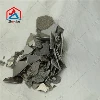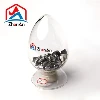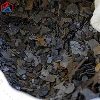

Ferro silicon 65 (FeSi65) is an iron-silicon master alloy with a guaranteed minimum silicon content of 65%, produced by carbothermic reduction of quartzite and carbon in submerged-arc electric furnaces. The tapped melt is cast, cooled, crushed and screened into the graded sizes used by steel mills and foundries. Sitting between the widely used FeSi75 grade and lower-silicon products, FeSi65 gives a balanced mix of deoxidising power, density and cost for bulk steelmaking.
Silicon has a strong affinity for oxygen, so FeSi65 is charged to the ladle or furnace to reduce dissolved oxygen before casting. That deoxidation step lowers blowhole and pinhole defects, improves the recovery of other alloying elements and increases the usable yield of every heat. The same addition raises the silicon level of the finished steel where the grade requires it.
Guaranteed Chemistry of FeSi65 and Neighbouring Grades
| Grade | Si min (%) | Al max (%) | S max (%) | P max (%) | C max (%) |
|---|---|---|---|---|---|
| FeSi65 | 65 | 2.0 | 0.02 | 0.04 | 0.2 |
| FeSi70 | 70 | 2.0 | 0.02 | 0.04 | 0.2 |
| FeSi72 | 72 | 2.0 | 0.02 | 0.04 | 0.2 |
| FeSi75 | 75 | 2.0 | 0.02 | 0.04 | 0.2 |
Grade designations follow the common GB/T 2272 and ISO 5445 convention, in which the number after FeSi states the minimum silicon content. The table lists standard guaranteed limits; tighter aluminium, sulphur or carbon windows are available for critical heats, and each lot is certified against the specification agreed for the order.
Why Direct Factory Supply Matters for Bulk Buyers
When ferro silicon passes through several trading layers, the buyer loses sight of the heat number, the screening step and the analysis certificate that actually belongs to the delivered material. Direct factory supply keeps one chain of custody from furnace to bag, because the same plant melts, casts, crushes, screens and packs the alloy, so chemistry and sizing stay linked to a single production record.
One production record per lot, traceable to heat number and screening date.
No intermediate trading margin, which keeps repeat-order prices stable.
Chemistry adjusted before packing rather than after, so delivered analysis matches the agreed limits.
Screening and packing controlled in the same plant, reducing fines generated in transit.
Size Ranges, Packaging and Customisation
FeSi65 is supplied in lump or graded sizes, with fines removed or retained according to the charging or injection system in use.
0-1 mm, 0-3 mm, 0-10 mm and 1-10 mm screened ranges.
Lump grading for furnace charging, screened to agreed top and bottom limits.
Packing in 25 kg bags, 1 mt jumbo bags or steel drums, palletised for container loading.
Custom screening and blending to suit a specific charging line.
Because the alloy is screened in-house, the size distribution is tuned rather than merely accepted, which matters when an injection line is sensitive to the proportion of fines.
Quality Control and Sampling
Production runs under an ISO 9001 quality system, with chemical analysis by ICP-OES supported by size analysis of every screened fraction. Samples are drawn from the lot rather than from a single bag, and a retained sample is kept so that a buyer's laboratory result can be compared with the supplier record. A certificate of analysis accompanies each shipment, and FeSi65 samples are supplied free of charge so that trial heats and laboratory evaluation can be completed before a bulk lot is committed.
Applications of FeSi65
Deoxidation of rimmed, capped and killed carbon steels during tapping.
Silicon alloying of structural, spring and electrical steels.
Inoculation and deoxidation in grey and ductile iron foundries.
Silicon source for magnesium ferrosilicon and other master alloys.
Alloying and reducing additions in welding consumable manufacture.
Frequently Asked Questions
Q: What is the guaranteed silicon content of FeSi65?
At least 65% silicon by mass. The plant normally targets the 65-70% band so that silicon, aluminium, sulphur, phosphorus and carbon all remain inside the agreed limits at the same time.
Q: How does FeSi65 differ from FeSi75?
FeSi75 carries a higher minimum silicon content, so less alloy is needed per tonne of steel for the same silicon addition, while FeSi65 is generally more economical per tonne and is preferred where the silicon requirement is moderate.
Q: Which size suits ladle addition?
Screened 1-10 mm and 0-10 mm fractions dissolve quickly in the ladle and are the usual choice for tapping additions, while coarser lump is used for furnace charging where slower, deeper solution is wanted.
Q: How is moisture controlled before shipment?
The alloy is dried and packed dry, bags are heat-sealed or stitched and palletised for container loading, and jumbo bags are fitted with lifting loops and discharge spouts for safe handling at the mill.
Q: Can size distribution be changed for a specific furnace?
Yes. Screening decks are set to the agreed top and bottom limits, so a mill can order a coarse lump grade, a fine injection grade or a blended lot without changing supplier.
Q: What documentation is issued with each lot?
Every shipment carries a certificate of analysis listing silicon, aluminium, sulphur, phosphorus and carbon, together with the lot number and the screened size range, so the material can be checked against the mill's incoming inspection record.