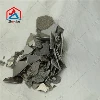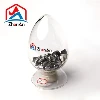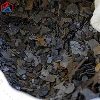

Ferrovanadium (FeV) is an iron-vanadium alloy primarily used as an additive in steel production to enhance strength, toughness, and wear resistance. Its properties vary depending on the vanadium content and manufacturing process.
1. Chemical Composition
Ferrovanadium is available in different grades based on vanadium content. The typical composition is:
| Grade | V (%) | Fe (%) | C (%) | Si (%) | P (%) | S (%) |
|---|---|---|---|---|---|---|
| FeV40 | 35-45 | Balance | ≤0.5 | ≤2.0 | ≤0.05 | ≤0.05 |
| FeV50 | 45-55 | Balance | ≤0.4 | ≤1.5 | ≤0.05 | ≤0.05 |
| FeV60 | 55-65 | Balance | ≤0.3 | ≤1.5 | ≤0.05 | ≤0.05 |
| FeV80 | 75-85 | Balance | ≤0.2 | ≤1.5 | ≤0.05 | ≤0.05 |
2. Physical Properties
Appearance: Grayish-black, metallic solid
Density: ~6.0–7.0 g/cm³ (depends on composition)
Melting Point: 1450–1600°C (varies with vanadium content)
Hardness: Brittle and hard
Magnetic Properties: Ferromagnetic
3. Chemical Properties
High Affinity for Carbon and Nitrogen: Forms strong carbide and nitride compounds, improving steel hardness and wear resistance.
Resistant to Oxidation: Vanadium enhances corrosion resistance in steel.
Reacts with Oxygen at High Temperatures: Forms vanadium oxides, requiring careful handling in high-temperature environments.