
What the 50 Actually Means
The 50 in FeV50 represents the vanadium content of the alloy - approximately 50% vanadium by mass. It does not describe purity, melting temperature or efficiency; it simply specifies how much elemental vanadium the alloy delivers when added to molten steel. Because vanadium is the active element, this percentage directly determines how much ferrovanadium must be charged to reach a target vanadium content in the steel. If the actual vanadium content deviates from the nominal value, the steel composition drifts and correction additions are needed, which costs time and alloy, so the certificate of analysis should always be checked against the target grade.
Ferrovanadium Grades Compared
Common ferrovanadium grades cover a wide range of vanadium concentrations: FeV40 contains about 40% vanadium, FeV50 about 50%, FeV60 about 60%, and FeV80 roughly 78–82%. The percentage controls how much alloy a mill needs to consume. Since FeV50 contains around half vanadium, supplying one kilogram of vanadium requires roughly two kilograms of FeV50, adjusted by the recovery rate. Higher-vanadium grades reduce the physical tonnage added, but they are not always more cost-efficient, depending on market conditions and melt behavior. This is why FeV50 remains the mainstream choice: predictable composition, stable availability and widely understood recovery patterns.
Why the Vanadium Percentage Matters to Steelmakers
The vanadium percentage is the basis of every dosing calculation. A consistent vanadium content allows the steelmaker to charge a fixed amount per heat with confidence, keeping the final chemistry on target and avoiding expensive corrections. This is especially important in grades where vanadium must be held within a tight window, such as high-strength rebar, microalloyed steels and spring steels. For this reason, buyers compare not only the nominal grade but also the batch-to-batch variation of the vanadium content shown on the inspection certificate.
Melting Behavior and Recovery
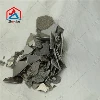
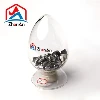
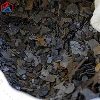
The vanadium content itself does not change the melting temperature dramatically, but FeV50 tends to offer balanced dissolution behavior because of its typical size range (for example 10–50 mm or 10–60 mm) and controlled impurity profile. Two batches with the same vanadium percentage can still behave differently if granularity or impurities deviate. For most mills, the predictable vanadium delivery and manageable density of FeV50 provide consistent vanadium recovery across BOF, EAF and ladle additions. Addition timing and stirring practice also affect recovery, so the same alloy can give different results in different furnaces.
Supporting Specifications beyond the 50
Vanadium percentage is only one part of the specification. Steelmakers look closely at impurity levels and granularity because both affect yield, slag behavior and inclusion control. Carbon influences weldability and the strength balance; sulfur and phosphorus must be kept within tight limits to prevent brittleness and toughness loss; aluminum and silicon affect deoxidation and slag chemistry; and particle size determines dissolution speed and vanadium recovery. In practice, a mill comparing FeV50 from different suppliers often makes its decision based more on these supporting specifications than on the vanadium percentage alone, because the percentage is only useful when the rest of the chemistry is under control.
Cost-Effectiveness: Cost per Kilogram of Vanadium
Steelmakers commonly compare FeV50 with FeV60 or FeV80 not by the price per ton of alloy but by the cost per delivered kilogram of vanadium. Because FeV50 sits in the middle range, it often offers stable availability and predictable economics, especially when melt recovery and size distribution are consistent. The 50 is therefore more than a label: it links directly to consumption rate, metallurgical efficiency and total alloy cost. The key when evaluating FeV50 for a specific steel route is matching grade, size and impurity limits to the furnace conditions rather than relying on the vanadium percentage alone.
FAQ
Q: What does the 50 in FeV50 refer to?
A: It refers to the vanadium content of the alloy - approximately 50% vanadium by mass - not to purity, melting temperature or efficiency.
Q: How does FeV50 compare with FeV40, FeV60 and FeV80?
A: FeV40 contains about 40% vanadium, FeV50 about 50%, FeV60 about 60%, and FeV80 roughly 78–82%; higher percentages reduce the tonnage needed but are not always more cost-efficient.
Q: Why is the vanadium percentage so important to steelmakers?
A: It controls how much ferrovanadium must be charged to reach a target vanadium content; since FeV50 is about half vanadium, supplying 1 kg of vanadium needs roughly 2 kg of FeV50, adjusted by recovery.
Q: Does FeV50's vanadium content influence melting and recovery?
A: Indirectly. The percentage itself does not change melting temperature much, but FeV50's typical size range and controlled impurity profile give balanced dissolution and consistent recovery across BOF, EAF and ladle additions.
Q: What other specifications matter besides the vanadium percentage?
A: Carbon, sulfur, phosphorus, aluminum and silicon levels, and particle size, because they affect yield, slag behavior, inclusion control, dissolution speed and vanadium recovery.
Q: How should mills compare FeV50 with FeV60 or FeV80 on cost?
A: By comparing the cost per delivered kilogram of vanadium rather than the price per ton of alloy, including the effect of melt recovery and size distribution.