
What Silicon Metal Powder Is
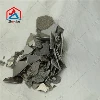
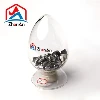
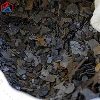
Silicon metal powder is produced by crushing, milling and grading metallurgical-grade silicon into controlled particle size fractions, most commonly between 45 µm and 3 mm. The base metal is specified under GB/T 2881, which fixes grade designations such as Si1101, Si2202, Si3303, Si4210 and Si5530 by limiting iron, aluminium and calcium. As a working example, Si1101 is ordered at Si 99.7% minimum with Fe 0.1% maximum, Al 0.1% maximum and Ca 0.01% maximum.
Chemistry decides the value of the silicon in the ladle or reactor. Particle size distribution decides whether the material can be injected, mixed, screened or reacted, and it also controls how much surface oxide the powder carries. Good purchasing practice specifies both, together with moisture and packing.
1. Aluminium Alloy Casting
Aluminium-silicon alloys are one of the largest outlets. A correctly inoculated melt gains fluidity, resistance to hot tearing, and lower shrinkage porosity, while wear resistance rises in piston and cylinder head castings. Powder is preferred over lump because the higher specific surface speeds dissolution and because the addition can be weighed accurately when silicon is being trimmed in the holding furnace. Casting alloys such as AlSi7Mg and AlSi12CuNiMg all depend on consistent silicon input, and a drift of a few tenths of a percent in the charge is enough to move mechanical properties outside the specified window.
2. Steelmaking and Foundry Deoxidation
Silicon has a higher affinity for oxygen than iron, so it acts as a deoxidiser and as an alloying element at the same time. Powder is added to the ladle or injected through a lance with a carrier gas, where the fine particles dissolve quickly and drop the oxygen level before casting. The same mechanism is used in the tundish during continuous casting. Silicon powder is also a standard constituent of cored wire for calcium treatment and of briquetted additions, where a free-flowing and consistent fraction prevents segregation in the feeder.
3. Refractory and High-Temperature Materials
In alumina-silicon carbide and alumina-magnesia-carbon refractories, silicon metal powder works as an oxygen scavenger. It reacts with oxygen and with carbon monoxide in the pore atmosphere to form new mineral phases that seal porosity, densify the matrix and block slag and iron penetration. Additions are usually a few percent by weight. The measurable effects are lower oxidation loss of the carbon bond, better thermal shock resistance and longer lining campaigns in ladles and tundishes. Fineness matters here, because the reaction is controlled by surface area rather than by total mass.
4. Silicone and Chemical Synthesis
The direct process for methylchlorosilanes reacts finely divided silicon powder with methyl chloride over a copper catalyst. Iron, aluminium and calcium in the feed affect both reaction rate and selectivity, so chemical-grade powder is ordered to tighter limits than metallurgical-grade material. Silicone fluids, elastomers and resins all trace back to this step, which makes powder quality a raw-material risk item for the whole silicone chain.
5. Solar, Electronic and Powder Metallurgy Feedstock
Metallurgical-grade silicon powder is also the input for upgraded metallurgical and chemical routes to solar-grade silicon. In powder metallurgy it is used for silicon nitride and silicon carbide synthesis, for sintered aluminium-silicon parts and in welding consumables. Each of these routes specifies a particle size band, a tapped density and a maximum oxygen content, because surface oxide on fine powder effectively removes silicon from the reaction.
Specification Checklist When Ordering
| Parameter | Typical requirement | Why it matters |
|---|---|---|
| Si content | 98.5% to 99.7% minimum | Reaction yield and alloy quality |
| Fe / Al / Ca | Set by grade under GB/T 2881 | Silicone selectivity and refractory compatibility |
| Particle size | 45 µm to 3 mm | Dissolution rate and injection behaviour |
| Moisture | Low and dry | Storage stability and gas pick-up |
| Packing | Sealed 25 kg bags or 1000 kg bulk bags | Contamination and oxidation control |
Frequently Asked Questions
Q: What does the grade name Si1101 mean?
A: The digits encode the impurity limits: Fe 0.1%, Al 0.1% and Ca 0.01%, with silicon at 99.7% minimum under GB/T 2881.
Q: Is fine powder always better than coarse?
A: No. Fine powder dissolves and reacts faster, but it carries more surface oxide, generates more dust and is harder to inject without segregation. The right band depends on the process.
Q: Why is silicon powder used in refractories at only a few percent?
A: It is an additive, not a bulk raw material. A small, well dispersed addition is enough to react with oxygen and carbon monoxide and densify the matrix.
Q: Can the same powder be used for aluminium casting and silicone synthesis?
A: Usually not. Silicone feed requires tighter control of iron, aluminium and calcium plus a defined particle size, so the two duties are bought to different specifications.
Q: How should the material be stored?
A: Keep bags sealed and off damp floors. Moisture pick-up reduces the effective silicon content and creates gas during melting or reaction.
Q: What documentation should come with a shipment?
A: Batch chemistry, particle size distribution by sieve analysis, moisture content and the packing list, so that the receiving inspection can be matched against the purchase specification.