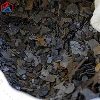

Coke is the main raw material and reducing agent in the smelting of ferrosilicon, so it is important that coke has a high fixed carbon content (more than 84%), while keeping the ash content low.
A high ash content leads to increased slag formation because the ash contains about 60% aluminium oxide (AI2O3), which makes the slag sticky and difficult to remove. Also, coke with a high ash content can make the surface of the material less breathable because it can make it sink. So, the ash content of coke should be kept below 13%.Most of the carbon in coke is in the form of fixed carbon, but a small fraction exists in the form of hydrocarbons, also known as volatiles. These volatiles evaporate at high temperatures, so their content should not exceed 2%.As well as the chemical composition, coke also has requirements for physical properties.The higher resistance to high temperatures allows the electrode to be inserted deeper into the charge, which increases the furnace temperature and expands the crucible.The high porosity of coke not only contributes to its resistance, but also increases the surface area for chemical reactions, thereby accelerating the reaction rate.
The size of the coke particles has a big impact on the smelting process. If the particles are too large, the charge resistance decreases, making it difficult for the electrode to penetrate deeply. This can lead to lower furnace temperatures, smaller crucibles and uneven melting.Conversely, if the particle size is too small or there is an excess amount of powder, it can lead to increased firing losses, causing the kiln to become sticky and air permeability. So, the coke must have a specific particle size, ideally less than 8 mm for large ferrosilicon electric furnaces.Smaller ferrosilicon electric furnaces, which operate at lower temperatures, use a "smoldering" process, and adding some coke powder can help sinter the surface of the material, allowing the electrode to be inserted deeper. So, a small amount of coke powder can be used to smelt ferrosilicon in low-power electric furnaces.