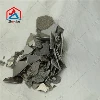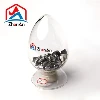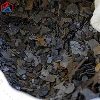

Low-grade silicon carbide is widely used to reduce erosion in refractory materials, especially in high-wear environments such as iron runners, slag lines, and rotary kilns.
In these applications, refractory linings are constantly exposed to molten phases, abrasive particles, and chemical attack, which accelerate material loss and shorten service life. By improving abrasion resistance and structural stability, low-grade silicon carbide provides a practical and cost-effective solution to these erosion problems.
What Is Low-Grade Silicon Carbide?
Low-grade silicon carbide generally refers to silicon carbide with lower SiC content and higher levels of impurities such as free carbon, silica, iron oxide, alumina, or other mineral components compared with high-purity grades.
From a refractory manufacturing perspective, low-grade silicon carbide is not simply a lower-priced substitute. Its value depends on how it is used in the formulation. For many refractory products, especially where cost control and wear resistance need to be balanced, low-grade silicon carbide can still provide meaningful performance benefits.
Why Erosion Happens in Refractory Materials
Erosion in refractory linings usually results from a combination of mechanical wear and chemical attack.
Typical causes include:
- continuous scouring by molten metal or slag
- abrasive movement of solid particles
- penetration of slag into the refractory structure
- oxidation and weakening of the matrix
- repeated thermal cycling that damages surface integrity
Once the matrix becomes weaker or more porous, molten phases can attack the lining more easily, accelerating material loss.
How Low-Grade Silicon Carbide Helps Reduce Erosion
The main reason silicon carbide is used in refractories is its excellent resistance to wear, high thermal conductivity, and relative chemical stability under many service conditions. Even when the grade is lower, it can still improve erosion resistance when properly selected and incorporated.
Improved Abrasion Resistance
Silicon carbide is a hard material. In refractory formulations, it can improve the lining's resistance to abrasive wear caused by slag movement, raw material impact, or high-velocity particles.
For applications where the erosion mechanism includes strong mechanical scouring, low-grade silicon carbide can still contribute to better surface durability and slower wear.
Better Slag Resistance in Practical Conditions
In many refractory systems, erosion is not just physical wear. It is often linked to slag penetration and matrix attack.
Low-grade silicon carbide can help by:
- reducing open porosity when properly graded
- improving matrix compactness
- slowing slag penetration in certain formulations
Although it may not match the performance of premium SiC in every severe environment, it can still improve resistance compared with formulations that do not use SiC at all.
Enhanced Thermal Conductivity
Higher thermal conductivity helps reduce local overheating and thermal gradients inside the refractory lining.
This can improve structural stability and reduce the formation of weak zones that are more easily eroded. In service environments where hot-face degradation is linked to thermal stress, silicon carbide can help maintain a more stable working surface.
Support for Stronger Bonding Structure
In some refractory products, low-grade silicon carbide can improve the overall microstructure when used with the right binders and aggregates.
It may contribute to:
- denser packing
- reduced crack propagation
- improved resistance to localized washout
Its effect is not only determined by purity, but also by particle size, distribution, and compatibility with the rest of the formulation.
Where Low-Grade Silicon Carbide Is Commonly Used
Low-grade silicon carbide is often used in refractory products where cost-performance balance is more important than extreme purity.
Typical applications include:
- castables for abrasion-resistant zones
- ramming mixes
- gunning materials
- tap hole and runner materials
- kiln furniture and selected shaped products
- refractory linings exposed to slag and particle erosion
In these applications, the goal is often to improve erosion resistance without pushing raw material cost too high.
Why It Can Be More Cost-Effective Than Higher Grades
One of the biggest advantages of low-grade silicon carbide is cost efficiency.
In refractory production, not every application requires premium-grade SiC. If the service condition is moderate or if the formulation is engineered correctly, low-grade material may provide enough performance improvement at a lower cost.
This means manufacturers can achieve:
- better erosion resistance than standard formulations
- lower raw material cost than using high-purity SiC
- improved service life without overdesigning the product
For many buyers, that balance is more important than chasing the highest possible purity.
Key Conditions for Good Performance
Low-grade silicon carbide is not a universal answer. Its effectiveness depends on how well it matches the refractory system and service conditions.
Important factors include:
- actual SiC content
- impurity type and level
- particle size distribution
- oxidation behavior at service temperature
- compatibility with binder and aggregate system
- slag chemistry and atmosphere in use
A lower-grade material can perform well in one application and poorly in another. That is why technical selection is critical.
When Low-Grade Silicon Carbide Is a Good Choice
Low-grade silicon carbide is usually a good option when:
- erosion is a bigger problem than extreme chemical corrosion
- the refractory needs better wear resistance at controlled cost
- the service environment does not require ultra-high-purity raw materials
- the producer wants to optimize formulation economics without losing too much performance
In these cases, it can act as a practical engineering material rather than just a budget alternative.
Comparison with High-Grade Silicon Carbide
The difference between low-grade and high-grade silicon carbide is not only purity, but also application target.
High-grade silicon carbide is generally preferred when:
- impurity control is critical
- oxidation resistance must be maximized
- the environment is more chemically aggressive
- the product is designed for premium performance
Low-grade silicon carbide is more suitable when:
- cost sensitivity is high
- the application is wear-dominant
- the refractory formulation can tolerate moderate impurity levels
- a balanced solution is preferred
The right choice depends on performance requirements, not on purity alone.
How Buyers Should Evaluate Low-Grade Silicon Carbide
When selecting low-grade silicon carbide for refractory use, buyers should not focus only on price.
More useful evaluation points include:
- actual SiC percentage
- Fe₂O₃ and other impurity levels
- bulk density
- particle size consistency
- stability between batches
- suitability for the intended refractory formulation
A reliable supplier should also be able to discuss the material in relation to actual refractory performance, not just chemical composition.
Conclusion
Low-grade silicon carbide can be an effective way to solve erosion problems in refractory materials when applied correctly. Its value lies in improving abrasion resistance, supporting matrix stability, and helping refractory producers balance performance with cost.
It is not simply a cheaper replacement for high-grade silicon carbide. In many industrial refractory applications, it can be a practical and technically sound solution for extending service life and reducing operating cost.
Looking for Silicon Carbide for Refractory Applications?
If you are selecting silicon carbide for castables, ramming mixes, or other refractory products, the right grade depends on your service conditions and cost target.
Contact us for specification support, particle size options, and the latest quotation for silicon carbide used in refractory materials.

ZHEN AN INTERNATIONAL CO.,LIMITED
ZhenAn is an enterprise specializing in Metallurgical & Refractory products , integrating production, processing, sales and importing and exporting business.
We are focused on building a dedicated team of professionals across the globe. At ZhenAn, we are committed to provide complete solutions by delivering the "right quality & quantity" to suite our customer's processes.
Annual production and sales more than 150,000 tons. Our factory covering an area of 30,000 square meters, it has a complete set of modern production equipment, two large production bases including hydro-metallurgy, two key laboratories and a metallurgical materials testing center with dozens of senior researchers.