
The Core Difference That Affects Dissolution
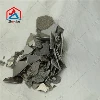
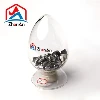
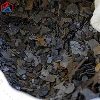
The key difference is vanadium concentration. FeV80 contains roughly 78 to 82 percent vanadium, while FeV50 contains around 50 percent. This changes two things: melting dynamics and heat absorption per kilogram. FeV80 is denser and melts more slowly, and it requires more thermal input to dissolve completely. The difference becomes more pronounced during tapping or late-stage ladle additions, where time and stirring energy are limited.
Why FeV50 Dissolves Faster in Most Furnace Routes
There are three practical reasons. First, FeV50 has lower density, so it settles and melts more quickly, especially in BOF and EAF tapping streams. Second, it is widely supplied in 10 to 50 mm or 10 to 60 mm size ranges that balance surface area and melting stability. Third, its lower vanadium concentration means less heat is required per kilogram of alloy, which makes FeV50 more forgiving across different melt temperatures and slag conditions.
When FeV80's Slower Dissolution Becomes a Challenge
FeV80 can be sensitive under certain conditions: short tap-to-ladle transition times, lower-than-ideal tapping temperatures, thick or high-viscosity slag layers, and furnace routes with minimal stirring. If dissolution is incomplete, operators may see reduced vanadium recovery, delayed alloy homogenization, and unpredictable precipitation timing of vanadium carbides and nitrides. Because FeV80 is dense, residual pieces may persist longer before fully reacting.
Vanadium Recovery: FeV50 versus FeV80
Contrary to intuition, FeV80 does not always give higher recovery despite its higher vanadium concentration. Recovery depends heavily on dissolution timing and slag interaction. At high melt temperature, FeV80 shows strong recovery but a slower start; at medium temperature, FeV50 remains stable while FeV80 may show partial dissolution delays. Under a thick slag cover, FeV80 has a stronger risk of oxidation near the slag-metal interface, and in a fast tapping sequence it is at risk of incomplete melting. FeV50 works well in the same conditions with fewer constraints.
Choosing Between FeV50 and FeV80
Choose FeV50 when you need fast dissolution, predictable recovery, and a size range that fits BOF and EAF routines. Choose FeV80 when micro-alloying requires high vanadium density and the melt can support its dissolution with sufficient temperature, stirring energy, or longer melting windows. FeV80 makes sense in tight-dosing programs, while FeV50 remains the more forgiving option for high-volume routes. The decision should reflect temperature profile, slag behavior, melt time, and recovery targets, not just the vanadium percentage.
FAQ
Q: What is the core difference between FeV50 and FeV80?
A: The vanadium concentration. FeV50 contains around 50 percent vanadium and FeV80 roughly 78 to 82 percent, which changes melting dynamics and the heat required per kilogram.
Q: Why does FeV50 dissolve faster?
A: It has lower density, commonly supplied 10 to 50 mm or 10 to 60 mm sizes, and a lower vanadium concentration that requires less thermal input, making it more forgiving across melt conditions.
Q: When does FeV80 dissolution become a problem?
A: With short tap-to-ladle times, lower tapping temperatures, thick slag layers, or minimal stirring, FeV80 can show incomplete dissolution, reduced recovery, and delayed homogenization.
Q: Does FeV80 always give higher vanadium recovery?
A: No. Recovery depends on dissolution timing and slag interaction. FeV80 can experience more oxidation near the slag-metal interface when it enters late and dissolves slowly.
Q: Which grade should be chosen for high-volume furnace routes?
A: FeV50 is generally the more forgiving option for high-volume BOF and EAF routes because it dissolves faster and gives more predictable recovery.
Q: What factors should the grade decision consider?
A: Temperature profile, slag behavior, melt time, recovery targets, particle size, and cost per effective kilogram of vanadium, rather than vanadium percentage alone.